

Published Nov 16, 2026 | 10:00 AM ⚊ Updated Nov 16, 2026 | 10:00 AM

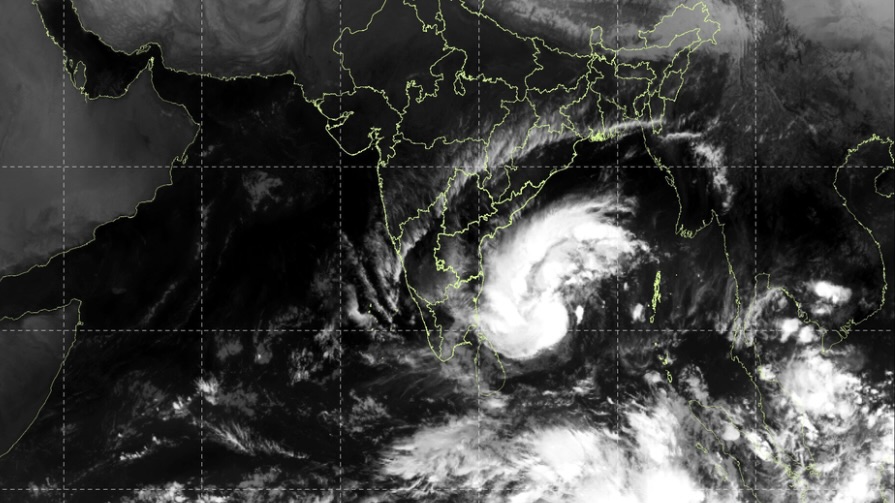
The system is expected to become a severe cyclonic storm over the west-central Bay by Tuesday evening.

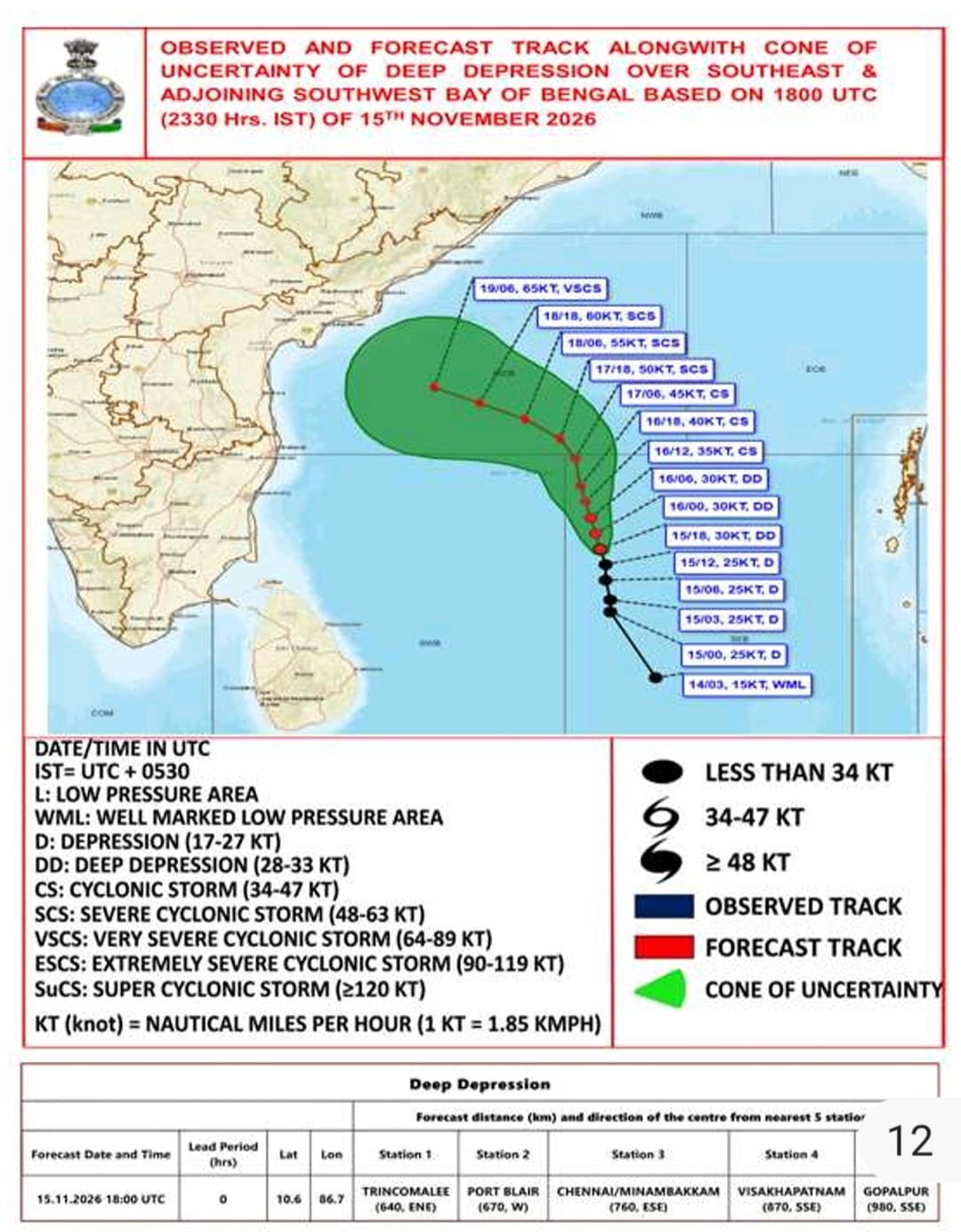
Synopsis: The deep depression over the Bay of Bengal is expected to strengthen into a cyclonic storm by Monday evening and a severe cyclonic storm by Tuesday evening, bringing heavy to very heavy rain and gusty winds to Coastal Andhra from Thursday through Friday, the IMD said. This is the third depression over the Bay of Bengal in less than a month to develop into a severe cyclonic storm, after Cyclones Arnab and Murasu.
The deep depression over the Bay of Bengal is expected to strengthen into a cyclonic storm by 5.30 pm on Monday, 16 November, with maximum sustained wind speeds of 60-70 kmph and gusts of up to 80 kmph, as the system continues to move steadily north-northwestwards towards the Andhra Pradesh coast, the India Meteorological Department (IMD) said.
This is the third depression over the Bay of Bengal in less than a month to develop into a severe cyclonic storm, after Cyclones Arnab and Murasu.
As of Monday morning, the system was centred about 720 km east-south-east of Chennai, 820 km south-south-east of Visakhapatnam and 940 km south-south-east of Gopalpur in Odisha.
The system is expected to become a severe cyclonic storm over the west-central Bay by Tuesday evening with wind speeds of 90-100 kmph and gusts of up to 110 kmph. By 12 am on Thursday, its maximum sustained wind speed is forecast to reach 110-120 kmph, with gusts of up to 130 kmph.
The Andhra Pradesh Disaster Management Authority said the cyclonic storm is likely to bring heavy to very heavy rain, accompanied by gusty winds, to Coastal Andhra from Thursday through Friday. Winds of 40-60 kmph are likely along the coast from Monday evening.
The authority has advised fishermen not to venture into the sea and warned coastal residents to remain alert. Farmers have been advised to take precautionary steps to protect crops ready for harvest, paddy and other agricultural produce.
Also read: Andhra Pradesh to vaccinate 10- and 16-year-olds against diphtheria and tetanus from 3 December
The threat of another cyclone comes as Andhra Pradesh is still recovering from the extensive damage caused by Cyclones Murasu and Arnab.
The Andhra Pradesh Disaster Management Authority said the cyclonic storm is likely to bring heavy to very heavy rain.
The two consecutive cyclones damaged agriculture, roads, irrigation infrastructure and power systems across the State. Preliminary estimates put the total loss at ₹2,484 crore.
Cyclone Murasu damaged crops across 1,43,617 hectares in the agriculture sector, affecting 1,86,063 farmers and causing losses estimated at ₹875 crore. Horticultural crops were damaged across another 6,756 hectares, affecting 12,605 farmers and resulting in losses of ₹337 crore.
Paddy crops had suffered damage of up to 80 percent in East Godavari district and 90 percent in Eluru district. Mango and papaya crops also suffered extensive damage.
Cyclone Murasu damaged 1,385 km of roads across the State, with the estimated loss pegged at ₹888 crore. In rural areas, 114 roads spanning 220 km were damaged. The Central team found that flash floods had caused extensive damage to roads and electric poles, particularly in rural areas.
In the irrigation sector, 369 structures were damaged and breaches occurred at 509 locations. Damage to the power infrastructure included 10,192 11-kV poles, 6,442 low-tension (LT) poles and 1,448 distribution transformers.
The cyclone also damaged 3,859 houses. The State government spent ₹37 crore on emergency relief measures.
Chief Minister N Chandrababu Naidu, at a virtual meeting with the Central team on Sunday, sought immediate assistance for Andhra Pradesh to deal with the damage caused by Cyclone Murasu. He explained the difficulties arising from consecutive cyclones and the El Niño effect and sought the Centre’s cooperation in strengthening infrastructure along the coast to prevent damage from future cyclones.
A seven-member Central team led by Union Home Ministry Joint Secretary Chittaranjan Dash toured the State to assess the damage caused by Cyclone Murasu. Divided into two groups, the team visited around 60 locations in Bapatla, Palnadu, Eluru and East Godavari districts.
The members inspected damaged crop fields, roads, canals, houses and other infrastructure and interacted with farmers and fishermen. Their visits included an inspection of damaged fishing boats in Chirala, crop losses in Surappagudem village in Bhimadole mandal, the drainage system at Ravulaparru and the Kommu canal at Kunakalamarru.
The Central team suggested examining the provision of rations three times over 30 days to families in rural areas whose kutcha houses were damaged. It also recommended special assistance for cyclone-affected tribal communities and consideration of higher compensation for farmers who suffered crop losses while practising natural and organic farming.
The team also noted that several farmers had been unable to insure their crops because of the high premiums charged for commercial crops.
(Edited by Dese Gowda)



