

Published Jan 11, 2026 | 10:15 PM ⚊ Updated Jan 11, 2026 | 10:15 PM

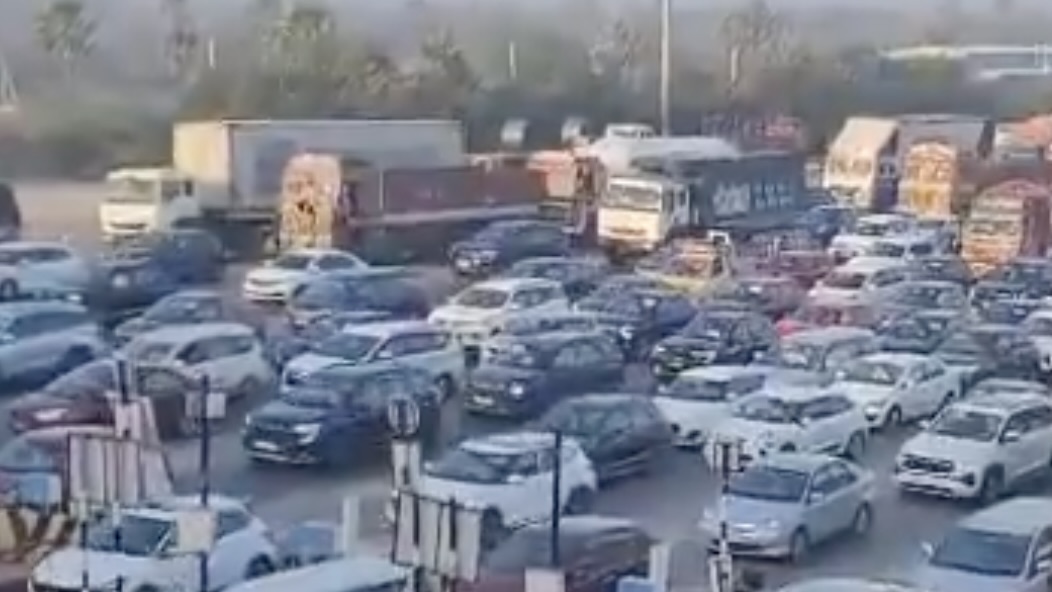
From early Sunday morning, vehicles were locked in bumper-to-bumper traffic, particularly at key choke points such as the Pantangi toll plaza near Choutuppal.
Synopsis: Heavy Sankranti travel brought the Hyderabad–Vijayawada National Highway to a near standstill on Sunday, 11 January, as lakhs of people left Hyderabad for their native places in Andhra Pradesh, stretching a normal four- to five-hour journey to eight or nine hours in many cases. Despite extra police deployment, temporary toll relaxations, diversions and special trains and buses, officials said the rush towards Vijayawada is likely to continue until January 13.
The Hyderabad–Vijayawada National Highway (NH-65), one of the busiest arterial roads connecting the two Telugu States, was choked with traffic on Sunday, 11 January, as a massive festive exodus ahead of Sankranti brought movement to a grinding crawl.
The congestion, which began building up from 9 January with the onset of school and college holidays, peaked over the weekend, catching both commuters and enforcement agencies in a familiar annual bind. This year, the rush appeared heavier than last year.
Every year, an estimated 20 to 25 lakh people head to Andhra Pradesh from Hyderabad for family reunions during the three days of Sankranti.
From early Sunday morning, vehicles were locked in bumper-to-bumper traffic, particularly at key choke points such as the Pantangi toll plaza near Choutuppal. Long queues stretched for several kilometres, with impatient drivers switching off engines and stepping out, resigned to a prolonged wait.
Though the authorities made arrangements for faster scanning of FASTag, it was of little help. Police deployed patrolling vehicles, cranes and ambulances at the Pantangi, Korlapahad and Chillkallu toll plazas in case the need arose.
As many as 70,000 vehicles crossed Pantangi between 6 pm on Saturday and 6 am on Sunday, according to officials.
Similar scenes unfolded at Chityal and Peddakaparthy in Telangana, and further along the corridor at Nandigama in Andhra Pradesh’s NTR district. The situation worsened at the Y-junction near Nandigama, where ongoing road widening and repair works narrowed the carriageway, effectively choking a highway already bursting at the seams.
With little room to manoeuvre, even emergency vehicles struggled to pass through the dense congestion.
What is typically a four- to five-hour drive between Hyderabad and Vijayawada stretched well beyond seven to eight hours, and even nine hours in several cases, testing the patience of travellers.
Buses, private cars, two-wheelers and goods vehicles crawled forward inch by inch, reflecting the scale of the annual homeward migration that Sankranti unfailingly triggers.
Traffic police and highway authorities sprang into action, deploying drones along critical stretches of NH-65 to monitor congestion hotspots in real time.
Additional toll booths were opened where possible, and toll operators were instructed to allow free passage whenever queues crossed permissible limits.
The measure proved to be a stopgap, easing pressure temporarily, but struggled to match the sheer volume of vehicles flooding the highway.
In an effort to decongest the main corridor, police diverted traffic through alternative routes via Bhongir, Ramannapeta and interior roads connecting Khammam and Guntur.
Soon, these alternatives too began witnessing a surge. Commuters were repeatedly advised to start early, avoid peak hours and exercise patience, counsel easier given than followed amid festival fervour.
Anticipating the surge, the Telangana government had earlier written to the Union Ministry of Road Transport and Highways, seeking toll-free movement on NH-65 from 9 January to 18 January.
Officials cited data indicating a nearly 200 percent jump in traffic during the Sankranti season, with last year alone seeing more than 2.5 lakh vehicles crossing the Pantangi toll plaza during peak days.
The ripple effect of the exodus is also visible beyond the highways. Railway stations in Hyderabad are teeming with passengers, prompting the South Central Railway to operate 10 special trains between Hyderabad and Vijayawada.
Both Telangana and Andhra Pradesh road transport corporations are operating thousands of buses to ease the rush.
Officials estimate that the outbound rush will continue until 13 January, with return traffic expected to peak between 16 and 19 January, once the Sankranti festivities conclude.
Authorities have urged travellers to monitor real-time updates through official traffic police channels and opt for public transport where feasible.


