

Published Jul 16, 2026 | 2:39 PM ⚊ Updated Jul 17, 2026 | 6:49 PM

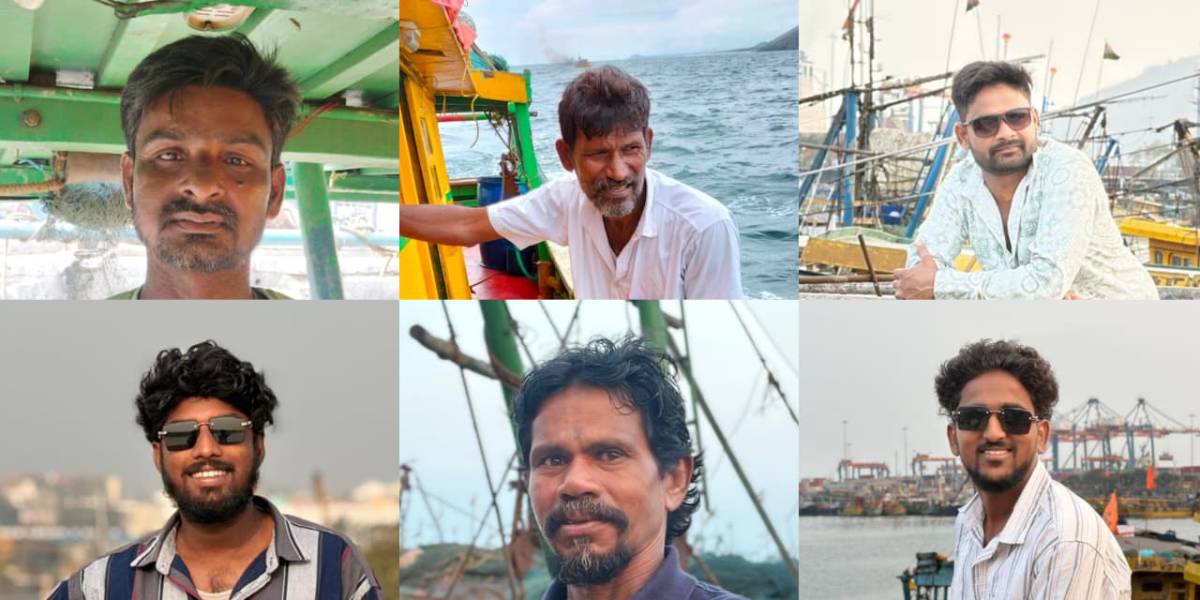
Lost fishermen, clockwise from top left: Raguthu Bandiyya, Kari Seethudu, Meda Chinna Ammoru, Kari Garagyaa, Kari Chinnayya, and Amara Appalaraju

Synopsis: Six of the seven fishermen aboard a vessel that capsized in the Bay of Bengal on July 4 have been presumed dead. One was an expectant father. Another told his brother, the only survivor, that he knew he was going to die before he went under water. The families hit by the tragedy have raised several concerns with the government’s response and are demanding higher compensation and answers. Activists also highlighted the many challenges small-scale fishermen face while venturing into the sea. Here are their stories and their concerns in their own voices.
Amara Appalaraju and Lakshmi had been married for less than a year and were expecting their first child together. But tragedy was to strike them.
Appalaraju was one of the seven men who left their homes for a fishing trip from the Vizag Fishing Harbour on a small mechanised boat on July 1. At the helm was boat owner-cum-driver Kari Chinna with a six-member crew on board. On their way back, as the boat neared the coast off Gangavaram on the afternoon of July 4, the crew rang their families to say they would be home in about two hours. This was to be Lakshmi’s final call with Appalaraju.
Lakshmi’s brother Malli Appalaraju said, “My sister last spoke to her husband around 2 PM that day. They were supposed to reach home by 4 PM.”
Lakshmi could not reach him by phone after that. She reached out to the families of other fishermen in the evening, who also said the men on board were unreachable.
It has been reported that a low-pressure system over the Bay of Bengal had churned the sea into rough swells, causing the fishing boat to capsize about 10 nautical miles offshore.
As part of a joint operation, the Indian Navy, Indian Coast Guard, and Marine Police were deployed for the search and rescue of the missing fishermen and the mechanised boat. On July 5, a merchant vessel spotted a lone swimmer, the boat owner Chinna, who had spent nearly 18 hours in the water. He was brought ashore by the Coast Guard and was admitted to a private hospital after a preliminary health checkup.
The search for the six other fishermen lasted four days, but was called off after a three-member committee appointed by the government of Andhra Pradesh declared in its report that they could be presumed dead. The Andhra Pradesh government has since announced a 10 lakh ex gratia payment to the grieving families.
But Lakshmi, Malli Appalaraju and the families of the other lost crew members have been protesting near the Vizag Port, demanding answers and higher compensation.
“They are giving us nothing. Most of it is the insurance money. Is the value of our lives just Rs 10 lakhs?” asked Malli Appalaraju, speaking to South First.
This came after what authorities claimed was a concerted bid to rescue the missing crew.
After the fishermen’s kin alerted authorities after being unable to reach the crew, Visakhapatnam Collector Abhishikth Kishore visited the AP Mechanised Fishing Boat Operator Association, which is near the Vizag Port and Vizag Fishing Harbour.
Speaking to the media, Kishore declared that a Joint Operations Centre had already been set up for the search and rescue and the Navy and the Coast Guard had been alerted the previous night. He announced that Kari Chinna was rescued by a Panama-flagged Chinese vessel, ‘Universe Wealthy’. Chinna was later airlifted by Indian personnel.
The Collector shared that two helicopters, two navy vessels, and one Coast Guard ship from Kakinada were deployed to find the missing crew members. The coordinated operation attempted to track the boat’s course using the transponder signals.
Chief Minister Chandrababu Naidu held a review meeting on July 5 and ordered the search-and-rescue team to expand the search radius along the Gangavaram Coast. Operations were intensified based on what Kari Chinna told them.
The Coastal Security officers said the rescue team battled extreme weather conditions at sea, including powerful gusts and waves up to four meters high. The AP Fisheries department issued advisories to fishermen, prohibiting fishing for the next few days.
Fisheries Commissioner Ram Shankar Naik met Kari Chinna and the families of the lost fishermen and promised that the government’s involvement would extend beyond the search itself and cover rehabilitation, livelihood support, and possible assistance for the lost vessel.
On July 6, the State government formed a three-member committee with the Revenue Divisional Officer, the Deputy Superintendent of Police, and the Assistant Director of Fisheries of Visakhapatnam district to probe the incident and enable the kin to receive ex gratia under the Group Accident Insurance Scheme (GAIS). The panel collected testimonies from Kari Chinna and the personnel who carried out the joint operation. They also analysed the Coast Guard and Navy logs. The report was submitted on July 8.
The committee’s report, accessed by South First, stated that the crew of seven fishermen set sail aboard a boat with registration number IND-AP-MM-V5-83. Alongside Amara Appalaraju were Raguthu Bandiyya, Meda Chinna Ammoru, Kari Chinnayya, Kari Seethudu, and Kari Garagayya. Besides the six, there was also Kari Chinna.
Four of the six missing crew members were originally from Bhogapuram in Vizianagaram and two from Visakhapatnam. They all lived in localities near the Visakhapatnam coast, such as Relli Veedhi, Jalaripeta, and Bukka Veedhi.
Kari Chinna told the panel that three of his crewmates had broken away to swim toward a cargo vessel visible in the distance as their own boat went down, but had lost touch with the rest of the group amid the confusion that followed.
The report suggested that the boat was toppled by strong winds and high waves, capsizing at around 2:30 PM on July 4 in the rough sea, right after the crew contacted their family members to inform them that they would be returning soon. It mentioned that the kin were only aware of the incident in the early hours of July 5. This ran contrary to what the families and the Vizag Collector had claimed earlier: that the authorities were alerted the previous night.
As per the First Information Report (FIR) filed by the One Town Police, Visakhapatnam, the fishermen were hurled into the sea and tried to swim in different directions in the hope of being rescued by nearby vessels.
The committee concluded that the six missing fishermen could not have survived and recommended that they be declared dead to enable compensation to be paid. The panel also identified the dependents of the missing crew and recommended that ex gratia payments be made directly to them. The State formally called off the search on Wednesday, July 8, four days after the boat went down, with neither crew nor wreckage recovered.
As mentioned earlier, the State government sanctioned a compensation of Rs 10 lakh for each of the six families, with Rs 5 lakh drawn from the Fisheries Department insurance scheme and Rs 5 lakh from the Chief Minister’s Relief Fund.
Minister Kollu Ravindra, accompanied by local legislators, the District Collector and the Fisheries Commissioner, handed the cheques to the families in person.
Kari Chinna, the only survivor, spoke to the media and said it was heartbreaking to see his crew members drift away.
“Kari Chinnaya went missing immediately after the boat overturned. But the rest of us held on to the boat for hours. We later swam to reach any nearby vessels we could spot,” said Chinna.
One of them was his brother, Kari Seethudu.
“My brother gave up after a while. He told me he was going to die,” shared Chinna, holding back tears. He added that he was the only one who managed to reach a vessel after swimming all night.
As the search for others continued, the bereaved families and fisherfolk gathered at the Mechanised Boat Owners’ Association office. They staged a protest on July 6, saying they were being kept in the dark about the search operation. They have been holding demonstrations every day since the day of the tragic incident.
Some protesters confronted Minister Rajendra during the compensation handover, insisting that they won’t accept a cheque as a substitute for the whereabouts of their husbands, sons, and brothers.
Malli Appalaraju told South First, “My brother-in-law was only 24. His wife is going to have their kid soon. Other crew members also have little kids. What about their upbringing and education?”
Vasupalli Janakiram, President of the East Coast Mechanised Fishing Boat Owners’ Association, asked, “The authorities were not being transparent about the rescue efforts. How did they expect the families to be okay with a cheque but no real answers?”
Unions and activists cited the recent tragic incidents in the state, such as the LG Polymers leak, after which the government announced Rs 1 crore in compensation to each victim’s kin. They urged the government to do the same for the dependents of the lost fishermen.
Arjilli Dasu, General Secretary of the Federation of Indian Fisher Organisations (FIFO), told South First, “According to the International Labour Organisation (ILO), fishing is one of the most dangerous professions in the world. The fisherfolk risk their lives every day. In the last decade alone, at least 700-1000 fishermen from the state died while on fishing trips. Fishing also requires a high level of skill; it cannot be termed as unskilled work. We urge the government to consider this and increase the ex gratia amount to Rs 1 crore.”
Vasupalli Janakiram alleged that the officials delayed the rescue efforts.
Speaking to South First, he said, “The families understood that something was wrong when they couldn’t reach the crew and informed me on the evening of July 4. I tried to alert the officials, but we did not receive a quick response.”
He claimed that the Collector responded late that night and assured them of immediate action.
“We also reached out to the Marine Police and the Fisheries Department. We sent them the details of the missing fishermen. They could have begun the rescue operation early. Nobody told us when the operations actually started,” said Janakiram.
Janakiram objected to the three-member committee report, saying it depicted an inaccurate account of the events.
“I met with the families of the missing crew on 4 July. We even posted a video that same night to spread the word. But the report falsely claimed that the kin only knew about the accident on July 5 . Was it done to conceal the fact that search and rescue was delayed?” he asked.
He said he had strong objections to the operations being called off by July 8, asking, “If you go by the report’s claims, the 72-hour window ends on July 9. Why was the search called off early?”
His association, Janakiram said, had written to Prime Minister Narendra Modi, Union Home Minister Amit Shah and Defence Minister Rajnath Singh seeking a central inquiry, and had separately approached the National Human Rights Commission, alleging a failure to protect the fishermen’s lives.
Arjilli Dasu told South First, “It was already late by the time the families realised that something had gone wrong. The authorities took even longer to respond.”
Dasu also hinted at a purported lack of coordination among the port authorities, the state, and the coast guard. “It was negligence on behalf of the state and total disregard for the lives of fishermen,” he added.
The Gangavaram tragedy is but the latest involving Andhra Pradesh’s fishermen and holds many lessons.
The state’s coastline has witnessed a recurring pattern of fishermen going missing or being stranded at sea over the past decade. The instances are almost always tied to a sudden deterioration in the weather or mechanical failure.
In December 2016, two fishermen from Kakinada rural mandal were swept into the sea when their boat with a seven-member crew struck an oil rig during Cyclone Vardah.
Cyclone Titli in October 2018 left three fishermen from Vizianagaram district missing after their boats were caught in the storm. Cyclone Phethai that same December saw a fishing boat carrying seven fishermen being reported missing off Visakhapatnam and a separate group of twelve fishermen from East Godavari lost their bearings entirely, drifting for two days before they were found safe on an island in Krishna district.
More recently, in September 2021, Cyclone Gulab capsized a boat off the Mandasa coast in Srikakulam, killing two fishermen and leaving a third unaccounted for.
Most recently, in the very week of the Gangavaram accident, a fisherman drowned when a vessel carrying a four-member crew overturned off the coast in Anakapalli district. Again in the same week, two separate crews of Andhra-registered trawlers had to be rescued by the Coast Guard after drifting into Odisha waters following engine breakdowns.
Across these cases, common causes resurface—boats venturing far out to sea in search of better catches without adequate means of tracking, crews delaying their return despite weather warnings because alerts fail to reach them once they’re beyond mobile network range, poorly maintained vessels, and an absence of basic safety equipment.
YSRCP president and former Chief Minister YS Jagan Mohan Reddy met with the protesting families at Vizag port on July 14 and said the Gangaravaram tragedy exposed how little real-time tracking from early-warning technology reaches small mechanised boats, leaving crews to fend for themselves the moment the weather turns.
Janikaram said that the Boat Owners’ Association has been demanding a modern, dedicated marine emergency response system for Andhra Pradesh’s coast, so that the next boat in distress is found before it is too late.
Teddu Shankar of ‘Sampradya Matsyakarula Sangham’ told South First that the authorities have not been effectively monitoring the safety of the fishing boats.
Any fishing boat that ventures into the sea must possess a registration certificate, a fishing license issued by the Fisheries Department, a permit from the port authorities, government-issued ID cards, and more documents depending on various factors. A safety inspection is mandatory before the vessel sets out into the sea.
“It is their (the authorities’) fault that they are not conducting proper checks. They are risking several lives by issuing permits without monitoring the vessels for safety equipment,” Shankar added.
Activists also raised a key issue with modern fishing. While traditional fishing knowledge has largely been lost, government-mandated training programmes to impart technical knowledge have been limited. They urged the officials to increase training programmes and widen their reach across the Coastal Andhra region.
A 2025 study conducted jointly by the Central Marine Fisheries Research Institute’s (CMFRI) regional centres along the Andhra Pradesh coast raised similar concerns. Covering Srikakulam, Vizianagaram, Visakhapatnam, Kakinada, Bapatla, and Nellore, the study surveyed fishermen, fisheries officials, and local institutional experts and revealed alarmingly low participation in these programmes.
The findings also point to a significant communication gap between fisherfolk, government administrators and research experts, weakening institutional linkages. To address this, the study recommended stronger outreach efforts, promoting training and digital tools, and building trust with fishing communities to support long-term, sustainable fisheries management.
The study revealed that access to training and compliance with safety and regulatory measures depended on the socio-economic condition of the fishermen and women.
Arjili Dasu said that his organisation has been campaigning for equipment such as life jackets, GPS, echosounder, and transponder to be made mandatory for all boats.
He noted that a crucial problem with small boats is an insufficient and expensive energy supply. Several fishermen turn off safety systems that could help save their lives in case of tragedy to save power. He said subsidised solar batteries could help them effectively tackle this problem.
“We have been urging the government to provide the safety equipment at a 90% subsidy, along with solar batteries,” said Dasu.
The CMFRI study also highlighted that most fishermen supplement their income with other economic activities, as fishing alone is often not enough to sustain a household. This is largely because fishing income tends to be unpredictable and is shaped by seasonal patterns, declining fish stocks, weather disruptions, and limited bargaining power in local markets.
At the same time, rising costs of fuel, gear, and boat maintenance continue to affect already thin margins. As a result, many fishing households turn to wage labour, small-scale trade, or tourism-related work to cover essentials such as education and healthcare, especially during fishing bans.
Teddu Shankar alleged that dealer syndicates in markets have been further squeezing small-scale fishermen.
“They target desperate fishermen in need of money by offering to purchase the catch on the spot if they could get a significant rebate,” he added.
The state government’s Matsyakarula Sevalo scheme was introduced to support fisherfolk during the periods of fishing ban. The scheme provides an allowance of Rs 20,000 per month through the ban.
The implementation of the scheme, however, remains inconsistent. The allowance is limited to one fisherman per family, ignoring the fact that it is a community occupation in which entire families work together. The scheme does not provide an allowance to fisherwomen.
“The government doesn’t even issue identifying cards to fisherwomen. So they remain unrecognised and unable to access the allowance,” said Shankar, who himself is a fisherman.
He also highlighted other irregularities, such as the allowance being tied to the electricity bill.
“They cut my allowance because I utilised more than 100 units of power per month for my home. We don’t understand how my electricity bill is related to the allowance,” he added.
Shankar said that the government should take into account the socio-economic conditions of the fishermen and step up to help the kin of lost crew members by offering higher compensation.
Meanwhile, activists said that protests at the Vizag port are expected to continue until the families get answers and accountability, not compensation alone, for the six men lost at sea in the Gangavaram tragedy.
The opposition parties, trade unions, fishermen associations, boat owners’ groups, and members of civil society have extended their solidarity to the demonstrations and urged the government to conduct a thorough investigation into the events that unfolded after the accident.
The organisations made it clear that they will not back down until the ex gratia amount is raised to Rs 1 crore.
(Edited by R Rajesh Kumar.)



