

Published Jan 13, 2026 | 8:00 AM ⚊ Updated Jan 13, 2026 | 8:00 AM

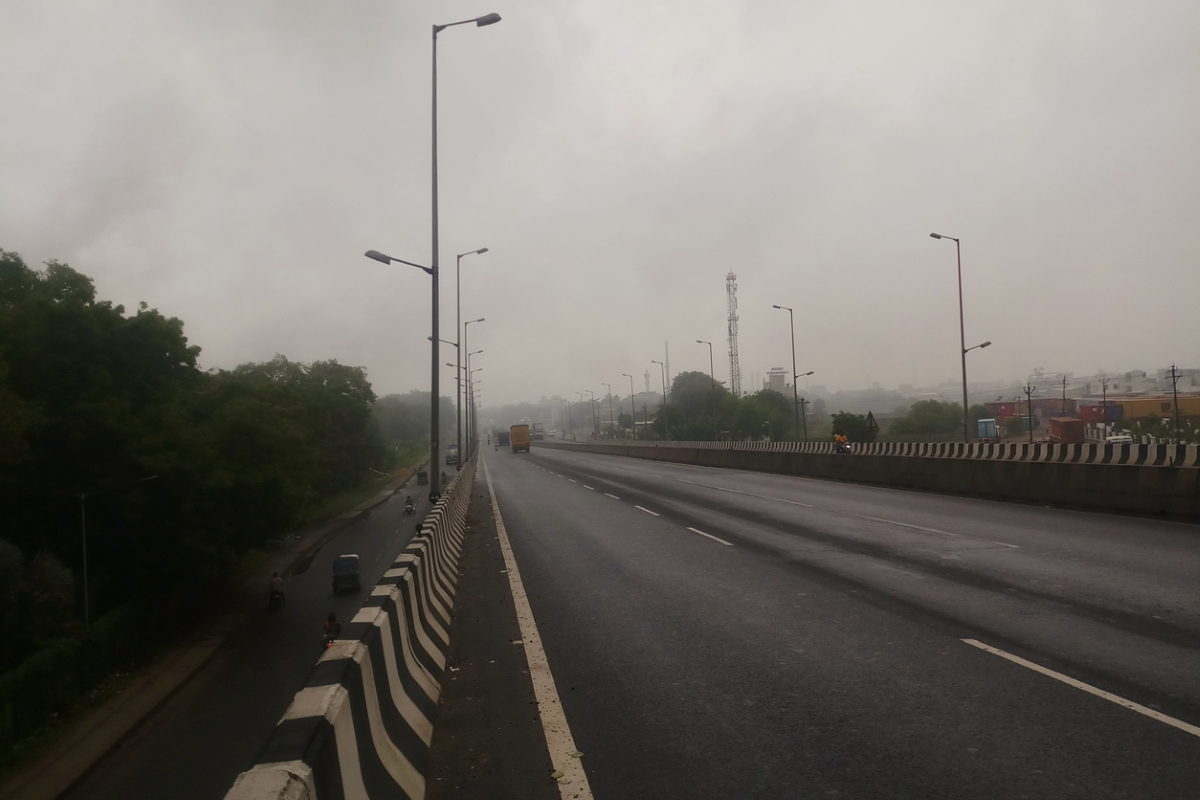
Highway. (Representational/ iStock)
Synopsis: The BKV Corridor, an under-construction six-lane access-controlled expressway, spans 518 kilometers from Bengaluru in Karnataka to Vijayawada in Andhra Pradesh, passing through Kadapa and traversing 11 districts—three in Karnataka and eight in Andhra Pradesh.
The National Highways Authority of India (NHAI) has crossed a major milestone in the construction of Bengaluru–Kadapa–Vijayawada (BKV) Economic Corridor, also known as National Highway-544G.
NHAI has created four world records in the initial phase of the construction itself. They were made near Puttaparthi in Andhra Pradesh’s Sri Sathya Sai district.
The NHAI achieved the two records in a 24-hour period on 6 January: Laying the longest stretch of bituminous concrete for 28.89 lane kilometers (equivalent to a 3-lane-wide, 9.63 km section) and the highest quantity at 10,655 metric tonnes.
Building on this momentum, NHAI teams, between 5 and 11 January, laid 57,500 metric tonnes of bituminous concrete and paved 156 lane kilometers (a 3-lane-wide, 52 km section), surpassing the previous global benchmark of 84.4 lane kilometers. By doing so, the NHAI has achieved total four Guinness Book’s world records.
Union Minister for Road Transport and Highways Nitin Gadkari, in a post on X on Sunday, 11 January said:” NHAI has set new global benchmarks in highway engineering. NHAI has created history by achieving two Guinness World Records in continuous Bituminous Concrete paving. These achievements highlight India’s rising leadership in world-class highway infrastructure and large-scale project execution.”
Addressed the programme on the Guinness World Record at Puttaparthi on the NH-544G Bengaluru–Vijayawada Greenfield Expressway today, along with Hon’ble Andhra Pradesh Chief Minister Shri @ncbn Ji and senior officials.
I congratulate Team NHAI and the Concessionaire, Rajpath… pic.twitter.com/an3W7UFRvP
— Nitin Gadkari (@nitin_gadkari) January 12, 2026
Andhra Pradesh Chief Minister N. Chandrababu Naidu lauded the effort, congratulating NHAI, state officials, and the concessionaire while urging sustained efficiency to wrap up the remaining works. “This is a testament to our commitment to world-class infrastructure,” Naidu stated, emphasizing the project’s role in Andhra Pradesh’s development agenda.
The BKV Corridor, an under-construction six-lane access-controlled expressway, spans 518 kilometers from Bengaluru in Karnataka to Vijayawada in Andhra Pradesh, passing through Kadapa and traversing 11 districts—three in Karnataka and eight in Andhra Pradesh.
The core greenfield section measures about 343 kilometers, with the total alignment incorporating upgrades to existing highways like NH-44 from Bengaluru to Kodikonda and NH-16 from Addanki to Vijayawada, bringing the effective corridor length to over 520 kilometers. Designed for safe, high-speed travel, it features 17 interchanges, 10 wayside amenities, a 5.3-kilometer tunnel, and eco-sensitive sections through forested areas like the Eastern Ghats.
Part of the Bharatmala Pariyojana Phase-II, the project is divided into 14 packages, awarded by February 2023 to contractors including Dilip Buildcon, Raj Path Infracon, and Megha Engineering & Infrastructures (MEIL).
Construction kicked off with preparatory works in March 2023, and Prime Minister Narendra Modi laid the foundation stone on 11 March, 2024. So far, the progress includes earthwork, embankment formation, and structures like bridges and flyovers. The recent record-breaking paving suggests accelerated momentum, with the full corridor targeted for completion by 2026 or early 2027 at a revised cost of ₹14,000 crore.
The economic implications for Andhra Pradesh are expected to be profound. Upon completion, the expressway will slash travel distance by approximately 100-112 kilometers (from 630-635 km to 518-535 km) and reduce time from 11-13 hours to 6-9 hours. This efficiency will create a vital logistics artery, linking Andhra’s port-led economy and industrial nodes like Koparthy with Bengaluru’s tech and manufacturing hubs.
For Andhra Pradesh’s Rayalaseema region—encompassing arid districts like Kadapa and Kurnool—the corridor promises a revival. Improved connectivity will enhance agricultural market access, fostering agro-processing industries and reducing post-harvest losses for crops like groundnuts, millets, and horticulture products.
The expressway will spur logistics parks, warehousing, and MSME clusters, attracting investments in sectors like electronics, automobiles, and food processing. Towns along the route, such as Pulivendula, Mydukur, Addanki, and Podili, might trigger real estate activitys, with rising land values, new townships, and infrastructure like schools, hospitals, and retail hubs. This could generate jobs in construction, logistics, and services.
Tourism is also expected to flourish, with easier access to sites in the Eastern Ghats, including temples in Puttaparthi and wildlife in Nallamala Hills. Environmental measures, such as tree planting and tunnels, ensure sustainable development, aligning with India’s green infrastructure goals.
As NHAI pushes forward, the BKV Corridor exemplifies how infrastructure can bridge regional disparities. For Andhra Pradesh, reeling from bifurcation challenges, this project might integrate remote areas into India’s economic mainstream.
(Edited by Sumavarsha)


