

Published Jan 08, 2026 | 4:52 PM ⚊ Updated Jan 08, 2026 | 4:52 PM

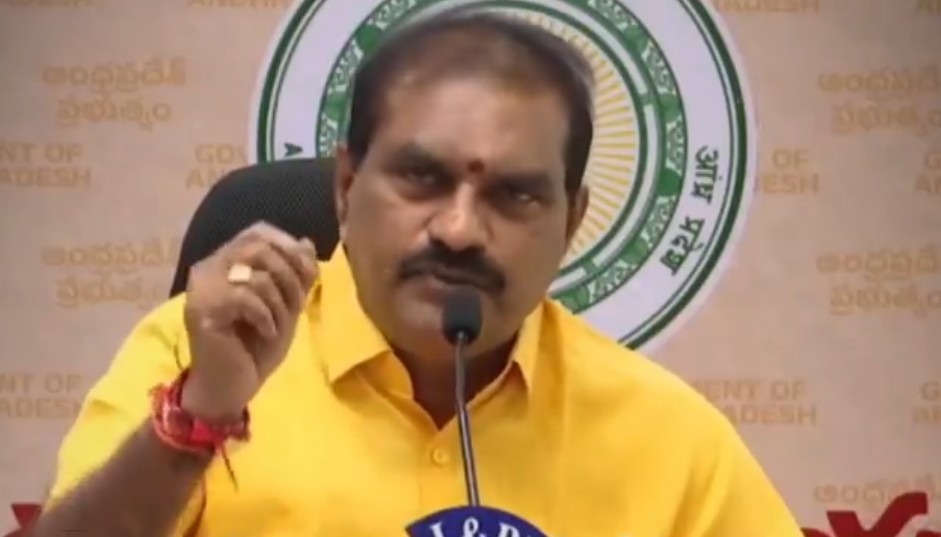
Andhra Pradesh Water Resources Development Minister Nimmala Ramanaidu. Credit: x.com/RamanaiduTDP
Synopsis: Andhra Pradesh Water Resources Minister Nimmala Ramanaidu defended shelving the Rayalaseema Lift Irrigation Scheme, citing negligible water gains, legal hurdles, and heavy costs. He accused the YSRCP of misusing funds on unviable projects penalised by the NGT, while highlighting TDP-led investments in Handri–Neeva and other reservoirs. Ramanaidu stressed sustainable, lawful projects have strengthened Rayalaseema’s irrigation backbone and ensured assured water supply.
The TDP-led NDA in Andhra Pradesh is seeking to downplay Telangana Chief Minister A Revanth Reddy’s assertion in the Assembly that his counterpart N Chandrababu Naidu had halted the Rayalaseema Lift Irrigation Scheme (RLIS) on his request.
Without referring to Revanth Reddy’s statement and skirting the point that the RLIS has been shelved, AP Water Resources Development Minister Nimmala Ramanaidu has recently argued that RLIS had offered negligible additional water benefits while burdening the State with huge financial, legal, and environmental liabilities.
Interestingly, neither Chandrababu nor Ramanaidu had denied shelving the project on the request of Telangana CM Revanth Reddy as the latter claimed on the floor of the Telangana Assembly recently.
Ramanaidu, on the other hand spoke of other irrigation projects in Rayalaseema and asserted that successive TDP governments had consistently safeguarded Rayalaseema’s water rights through sustainable, legally sound and technically viable irrigation projects.
Speaking to media persons at the state secretariat a few days ago, Ramanaidu said Rayalaseema’s irrigation backbone was laid during the tenures of NT Rama Rao and Chandrababu Naidu, transforming what was once a drought-prone region into a steadily irrigated agrarian zone.
“Every major reservoir and canal system that sustains in Rayalaseema today owes its origin to the vision, resolve, and administrative capability of NTR and Chandrababu Naidu,” he said.
The minister brought to the fore the technical and legal grounds for abandoning the RLIS, which was proposed by the previous YSRCP government in 2020. He pointed out that Rayalaseema is already receiving Krishna waters up to the 841-foot level from the Srisailam reservoir through gravity, without any lifting cost. In contrast, the RLIS was designed to lift water only from the 800-foot level.
He said: “At that level, the total water availability itself is just 34 TMCFT. As per Krishna River Board allocations, Andhra Pradesh’s share is only 66 percent—around 22 TMCFT. Even this quantity is already being drawn through existing lift systems at Malyala (834 feet) and Muchumarri. The RLIS, therefore, would not have brought any meaningful additional water to Rayalaseema,” Ramanaidu said.
He further explained that despite being granted administrative approval of ₹3,850 crore in 2020, the project was taken up without a Detailed Project Report or environmental clearance. This prompted the National Green Tribunal to halt works on May 20, 2020, and later imposed a penalty of ₹2.65 crore in March 2024.
According to official records, ₹990 crore was spent in the name of the RLI project—₹390 crore on civil works, ₹283 crore on mechanical works, ₹134 crore towards bank interest and ₹183 crore under other heads—without a single drop of water reaching Rayalaseema. “Continuing such a project would have meant throwing good money after bad and exposing the state to further penalties,” the minister said.
Ramanaidu accused YSRCP of misusing public funds in the name of Rayalaseema development. He cited the GNSS–HNSS link project, estimated at ₹5,036 crore, where works were taken up without land acquisition or environmental clearances, resulting in payment of bills worth ₹1,067.74 crore mostly for earthworks in soft soil stretches.
He also referred to the Mudivedu, Netiguntapalli, and Avulapalli reservoir projects, taken up without statutory clearances. Despite spending nearly ₹700 crore, the projects attracted an NGT penalty of ₹100 crore. “Farmers’ lands were taken without paying compensation, and thousands of crores of public money were wasted in five years,” he alleged.
Contrasting this with the TDP’s record, Ramanaidu said the NDA government had focused on strengthening and optimally utilising existing, legally approved projects that ensure assured water to Rayalaseema. He highlighted massive investments made within a short period after the coalition came to power.
For the Handri–Neeva project alone, ₹3,880 crore was spent in a year, compared to just ₹514 crore spent over five years earlier. An additional ₹3,145 crore was invested to ensure Krishna waters reached the tail-end of the Kuppam branch canal and extended up to the 490-km Madakasira branch canal. As a result, farmers are now able to take up a second crop, he said.
The government has also sanctioned ₹58.5 crore for Gorakallu reservoir, ₹4.5 crore for Owk reservoir, ₹36 crore for Alaganur balancing reservoir, ₹54.42 crore for Tungabhadra repairs and ₹203 crore for Srisailam plunge pool repairs. When a Tungabhadra gate was damaged, a new stop-log gate was installed within five days, which Ramanaidu cited as evidence of responsive governance.
The minister said Rayalaseema’s reservoirs were now brimming due to efficient water management. Of the 17 major reservoirs in the region, 86 percent storage has been achieved, while medium reservoirs stand at 67 percent and minor irrigation tanks at 53 percent. Against a total storage capacity of 464 TMC, around 366 TMC—nearly 79 percent—is currently filled.
He added that lining works at the Pothireddypadu head regulator are progressing rapidly, doubling water conveyance capacity and helping store Krishna floodwaters that would otherwise flow into the sea.
Ramanaidu said the government was also focusing on long-term solutions, including the Polavaram–Bollapalli–Krishna link to harness 3,000–4,000 TMC of Godavari floodwaters annually. Through the Bollapalli reservoir, with a capacity of 178 TMC, water would be supplied to Rayalaseema, Banakacherla, and Nallamala Sagar regions.
Rejecting what he termed “false propaganda” by the main Opposition on the shelving of the RLIS, the minister said people would not be misled.
“TDP’s approach has always been to protect Rayalaseema’s rightful share of water through sustainable, lawful, and cost-effective projects. Our focus is on delivering water,” he asserted.
(Edited by Amit Vasudev)


