


According to sources, the decision to challenge the Railway Court's acquittal order was not made by the political leadership.

Published Jun 03, 2025 | 8:00 PM ⚊ Updated Jun 03, 2025 | 8:00 PM

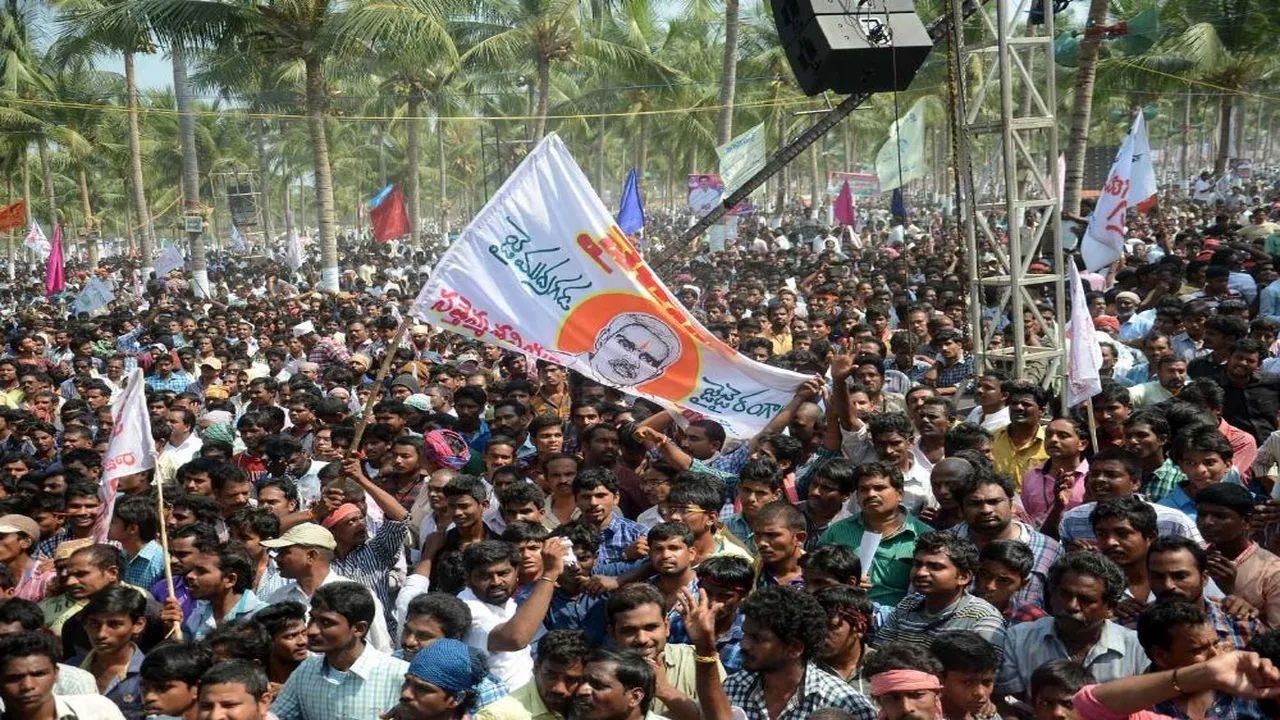
Kapu Garjana was held in 2016 to demand BC status for the community.
Synopsis: The GO issued on Monday, 2 June, authorising the filing of an appeal against the acquittal of accused individuals in the case of burning of the Ratnachal Express at Tuni (Crime No. 77/2016) in East Godavari district, has left the political leadership of the state red-faced.
Sensing severe political backlash from the Kapu community, the Andhra Pradesh government on Tuesday, 3 June, reversed a GO, which had authorised the filing of an appeal against the acquittal of 41 people in the 2016 Tuni arson case.
Home (Courts-B) Department issued GO. RT. No. 869 withdrawing its earlier order (GO. RT. No. 852, dated 2 June 2025) that had directed the Public Prosecutor, High Court of Andhra Pradesh, to challenge the acquittal judgment passed by the VII Additional Metropolitan Magistrate Court for Railways, Vijayawada.
According to sources, the government was upset over the GO and warned the officials against making decisions without consulting the political leadership.
The GO issued on Monday, 2 June, authorising the filing of an appeal against the acquittal of accused individuals in the case of burning of the Ratnachal Express at Tuni (Crime No. 77/2016) in East Godavari district, has left the political leadership of the state red-faced.
This is because the accused persons in the case belong to the Kapu community. They had allegedly resorted to arson and vandalism after attending a public meeting at Tuni addressed by BC leader Mudragada Padmanabham and others, demanding BC status for Kapus.
Reopening of the case has the potential to turn politically sensitive as the Kapu community is numerically strong in the coastal belt of Andhra Pradesh. After the GO became public, Deputy Chief Minister Pawan Kalyan, who belongs to the Kapu community, was upset.
According to sources, the decision to challenge the Railway Court’s acquittal orders was not made by the political leadership. As there might be a severe political backlash from the Kapu community, who can make or mar the fortunes of any political party in Andhra Pradesh, an informal inquiry has been ordered to find who had issued the controversial GO, and whether there was any ulterior motive.
Sources said that a damage control operation is now underway in the government. The issue of the GO RT No.. 852 exposed the glaring lack of coordination between the officials and the political leadership on important decisions.
The case, registered under Sections 146, 147, 153, and 174(a) & (c) of the Railway Act, was acquitted by the VII Additional Metropolitan Magistrate Court for Railways, Vijayawada, C.C. No. 97/2021, on 1 May 2023.
Meanwhile, Kapu leaders condemned the issuance of the GO and attributed motives to the TDP government.
Said Kapunadu West Godavari district president Chinamilli Venkatarayudu: “Chandrababu Naidu is anti-Kapu. The clearance given for challenging the Railway Court order is only intended to persecute the Kapus. We will teach him a lesson.”
Another leader, Bandi Srinivasa Rao, Kapu Ikya Vedika leader from Eluru district, said: “Reopening of the case is nothing but vendetta politics. The burning of the train is a long-forgotten incident. Kapus are viewing the decision of the government seriously. The government has hurt the feelings of the Kapus.”
The incident took place during the first term of N Chandrababu Naidu as the chief minister in the truncated Andhra Pradesh between 2014 and 2019, and the acquittal of the accused in the case took place when YS Jagan Mohan Reddy was in power between 2019 and 2024.
After Chandrababu Naidu took over once again as the chief minister in 2025, the Home Department issued the GO authorising the Public Prosecutor of the High Court of Andhra Pradesh to challenge the acquittal orders of the Metropolitan Magistrate Court for Railways.
The decision followed the recommendations from the Senior Divisional Security Commissioner, RPF, SC Railways, Vijayawada, and the Public Prosecutor’s opinion, dated 19 March.
The appeal was to be filed under Section 419 of the BNSS, 2023, the GO said, and asked the Public Prosecutor to take immediate action to ensure compliance and avoid legal complications. The GO was issued by the Principal Secretary to the Government (Home), Kumar Vishwajeet.
On 31 January 2016, a massive protest organised by the Kapu community in Tuni, East Godavari district, turned violent, culminating in the arson of the Ratnachal Express travelling from Visakhapatnam to Vijayawada.
The demonstration, named “Kapu Garjana” (Roar of Kapus), was spearheaded by former minister and Kapu leader Mudragada Padmanabham, demanding the community’s inclusion among the Backward Classes.
Despite the Telugu Desam Party (TDP) promising reservation before the 2014 elections, delays in implementation had escalated frustrations, leading to the agitation.
Thousands of protesters gathered for a public meeting at Velama Kothuru near Tuni. However, the situation quickly spiralled out of control when agitators stormed the Tuni railway station, blocking tracks, while several others pelted stones at the Ratnachal Express, and set multiple coaches on fire.
The violence extended beyond the railway station, with attacks on police stations, burning of police vehicles, and blockades on the Chennai-Kolkata national highway, causing widespread disruption. There were no passenger deaths, but several railway staff and police personnel were injured, and the railways suffered damages worth ₹41 crore, including the destruction of a new locomotive.
The protest carried strong political overtones, with participation from prominent Kapu leaders across parties, including YSRCP’s Botsa Satyanarayana, Congress’s Pallam Raju, and former Union Minister Vatti Vasantha Kumar, all Kapus.
The Railway Protection Force (RPF) and Government Railway Police (GRP) filed cases against 41 individuals linked to the train arson. Charges included:
The Crime Investigation Department (CID) identified nearly 500 suspects involved in related violence, using call records, video footage, and CCTV evidence, though only 41 were directly implicated in the train burning case.
Key figures named as accused in the case:
(Edited by Majnu Babu).


