

Published Oct 23, 2026 | 7:00 AM ⚊ Updated Oct 23, 2026 | 7:00 AM

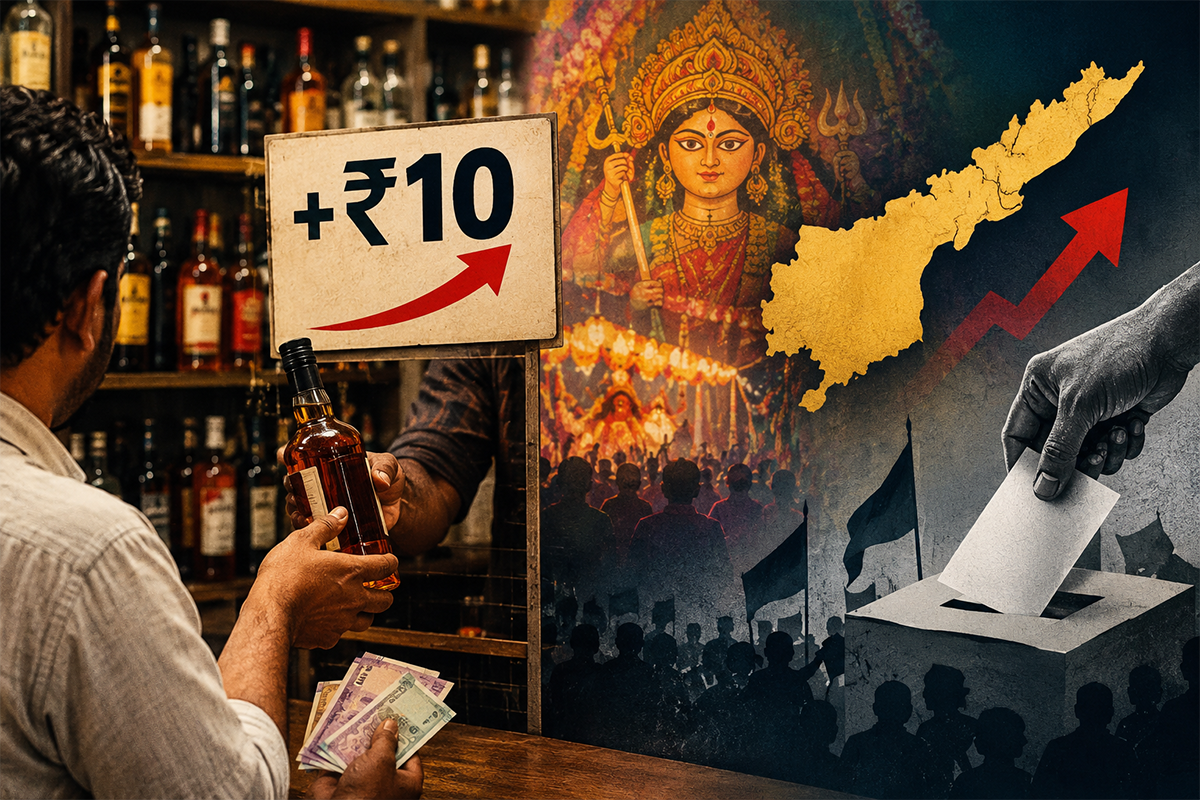
Liquor shops charged consumers extra during the festive season.

Tipplers in Andhra Pradesh are a disgruntled lot this Dasara season. Though the festival, which celebrates the victory of good over evil, has nothing to do with it, the state’s upcoming local body elections have sparked the anger.
They have to shell out an additional ₹10 per bottle for a swig during the festival, over and above the official price.
In January this year, the government had officially hiked the price of each bottle by ₹10. Barely months down the line, tipplers are paying more than the maximum retail price thanks to an unofficial price hike.
The price hike — linked by some to the local body polls and related expenses political parties have to meet — has also taken effect in all the liquor shops. Recently, under the new liquor policy in Andhra Pradesh, a permit room was made mandatory for every liquor shop. For this, the government collected a fee ranging from ₹5 lakh to ₹7.50 lakh, depending on the population served by each liquor shop.
Festivals, especially Dasara, boost liquor sales in Andhra Pradesh. Ravi, a businessman from Tadepalli on the outskirts of Vijayawada, said liquor shops charged consumers extra during the festive season. He said bars and restaurants normally charge ₹20 in non-AC and ₹40 in AC above the MRP. For the past four to five days, they have been collecting an additional ₹10 on top of this charge.
Srikanth Reddy from Undavalli confirmed that in Guntur district they have been collecting an additional ₹10 on liquor over the past week. He said the reason for collecting this additional ₹10 is being openly stated.
Andhra Pradesh is heading to local body elections. Political bosses have set targets for liquor syndicates and licensed traders, who have in turn started charging ₹10 extra per bottle.
Vijayawada-based restaurateur Venkateswara Raju admitted to collecting an extra ₹10 due to the one-year extension of liquor shop licenses, the burden of permit room fees, and other pressures. He clarified that a single person cannot decide on a price hike and that traders make the decision collectively.
He noted that they run liquor businesses in several areas of the city along with partners, and none of them wanted trouble. He refused to disclose who had issued the order or set the target.
Andhra Pradesh sells an average of 7.63 lakh beer bottles and cans daily. At an extra ₹10 per bottle, the additional amount earned daily is ₹76.30 lakh, which rises to ₹22.89 crore a month (30 days) and a staggering ₹278.50 crore per year.
Prasada Reddy, who runs liquor shops in Guntur district, explained that even if liquor sold directly at the counters in wine shops were excluded, at least half of the sales would still carry the additional collection. He said that everyone has to pay a share of the amount collected above the MRP. He stated that for liquor syndicates to run their business everywhere, orders coming from the top must be implemented, adding that these orders are never in writing.
None of them identified the “top”.
In Andhra Pradesh, 414 lakh cases of liquor are sold annually. Each case contains fifty 180 ml bottles.
Across the state, an average of 50 lakh quarter bottles of liquor are sold daily. If an extra ₹10 is collected per bottle, the daily collection would be ₹5 crore.
Officials claimed the Excise Department controls prices in licensed wine shops, but price control in bars and restaurants isn’t under their purview.
In Andhra Pradesh’s annual sales for the 2025–26 financial year, beer sales stood at 232 lakh cases, while Indian Made Foreign Liquor (IMFL) sales were recorded at 414 lakh cases. According to 2025-26 financial year statistics, the total value of these sales is ₹31,237 crore. Beyond liquor sales, the Andhra Pradesh government has no other major source of revenue.
In 2024–25, this stood at ₹29,440 crore. In one year, the sales value had increased by ₹1,797 crore.
The government brought the retail liquor shop policy for the 2026–27 financial year into effect from 1 October. It decided to continue operating 3,736 liquor shops statewide. Of these, 3,396 shops are in the general category, while 340 shops are reserved for Toddy Tapper (Geetha) communities.
The new policy will remain in force until 30 September 2027. The renewal of liquor shop licenses, allocation of remaining shops through a lottery, digital monitoring, and maintenance of stock details have been incorporated into this policy.
A non-refundable application fee of ₹3 lakh per shop was fixed for new licenses. Licensees opting for renewal must pay the annual Retail Excise Tax (RET) along with a renewal RET equivalent to 38 per cent of the annual RET.
For 2026–27, the annual RET rates have been maintained at the previous year’s levels. For general category shops, the renewal RET has been fixed at ₹23 lakh in areas with a population up to 50,000; ₹27.2 lakh in areas with a population between 50,000 and 5 lakh; and ₹35.5 lakh in areas with a population above 5 lakh.
For shops reserved for Toddy Tapper communities, these amounts are ₹11.5 lakh, ₹13.6 lakh, and ₹17.8 lakh, respectively. Where applicable, a permit room licence and its associated tax payments are also mandatory.
The government has raised ₹817 crore in revenue from liquor shop licence renewal RET and application fees. While it was estimated that this system would generate around ₹900 crore in revenue, collections nearly reached that figure within the first week of October itself.
Also Read:
Violence in AP: Supreme Court asks Election Commission to defer publishing final list of candidates
(Edited by Majnu Babu.)



