


Published Dec 31, 2025 | 1:00 PM ⚊ Updated Dec 31, 2025 | 1:00 PM

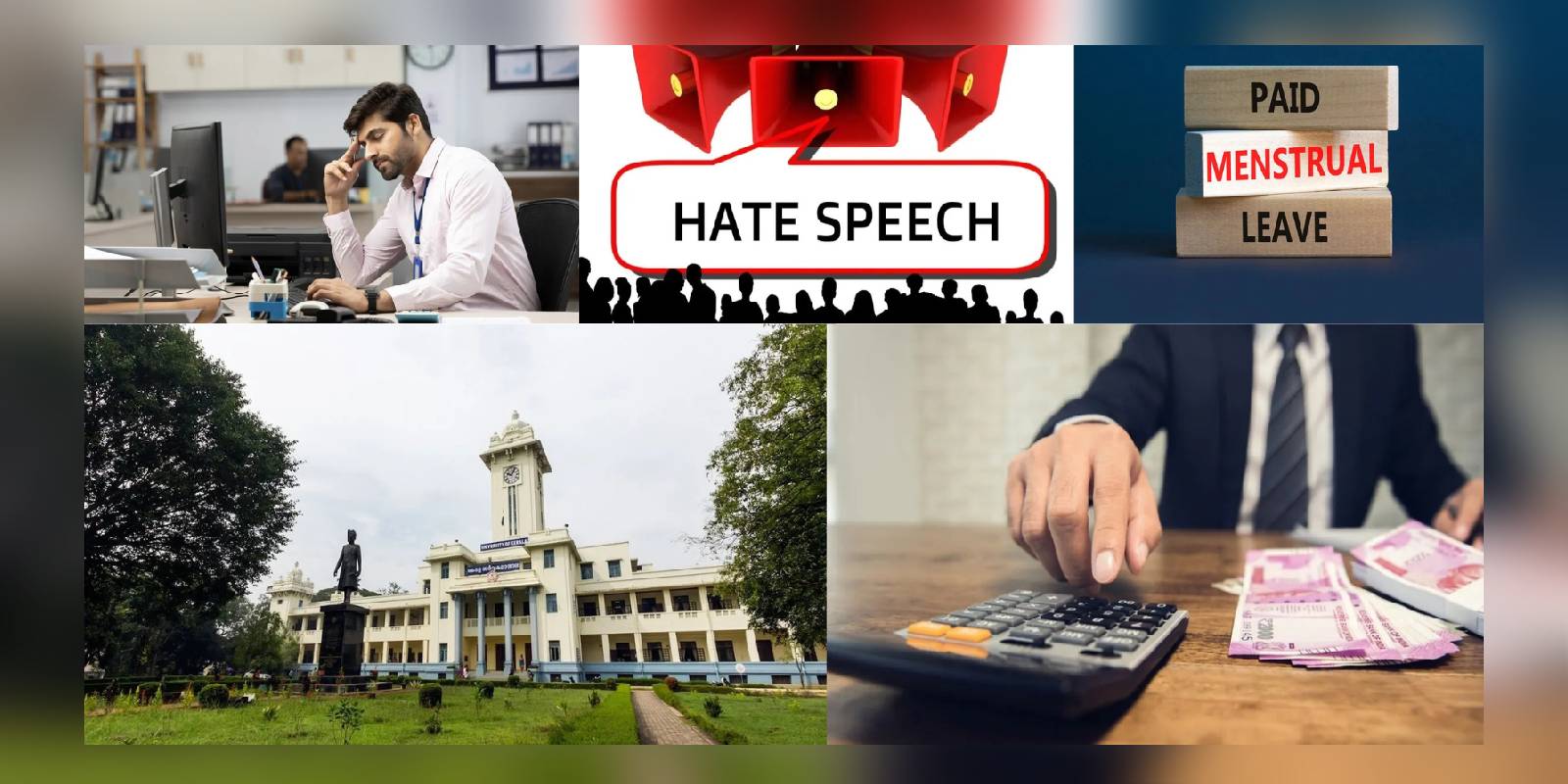
Legislations across south India in 2025. (Supplied)
Synopsis: From Kerala’s Right to Disconnect Bill 2025 to Karnataka’s Menstrual Women Well-Being Leave Bill, 2025, Southern states of India introduced many prominent legislations. While a few have been passed by the respective assemblies, a few others are awaiting to become acts.
Here is the list of important legislations passed in 2025, state wise.
The Karnataka Legislative Assembly in August 2025 passed the Karnataka Platform-Based Gig Workers (Social Security and Welfare) Bill, 2025, extending legal protection and welfare provisions to lakhs of workers in the gig economy. The legislation proposes a welfare fee of between one and five percent on aggregators, which will be directed into a dedicated fund for gig workers.
The Bill provides for the creation of a welfare board with representatives from the government, workers, platforms, civil society, and subject experts – four worker representatives, four platform representatives, and two civil society experts. The board will be responsible for managing welfare schemes, ensuring compliance, and making policy recommendations.
The Karnataka government on 12 November, issued a government order notifying the new menstrual leave policy, mandating employers to provide 12 days of paid menstrual leave per year (one leave per month).
The order applied to all permanent, contract and outsourced women employees between the age group of 18 and 52 working in all industries and establishments registered under the Factories Act, 1948, Karnataka Shops and Commercial Establishments Act, 1961, Garden Workers Act, 1951, Beedi and Cigar Workers (Employment and Conditions) Act, 1966, and Motor Transport Workers Act, 1961.
It was the first-of-its-kind policy across the country that provided the leave to women working in both government and private sectors.
While the policy is currently facing legal scrutiny after two private entities challenged the state’s authority to implement such a policy via only a GO, the government has also drafted a bill to this effect.
An initial version of the bill, titled the Karnataka Women Well-Being Leave Bill, 2025, proposes a monthly menstrual leave, not just for women working in private establishments and under the services of the government, but also for menstruating persons in educational institutions. The Bill extends the provision of menstrual leave to women, transgender persons, and girl students in educational institutions.
The Karnataka government in December 2025 tabled a first of its kind legislation to tackle hate speech— The Karnataka Hate Speech and Hate Crimes (Prevention) Bill 2025 —in the state legislative assembly.
The objective is to “curb and prevent dissemination, publication or promotion of hate speech” and also provide adequate compensation to the injured victims. It provides for stringent punishment of up to 10 years of imprisonment. More importantly, it gives the government power to block or take down online content that is deemed to be hate speech— a power that has raised concerns of arbitrary takedown of content by the state.
However, section 4 titled ‘Preventive action to be taken by the law-and-order machinery’ gives “arbitrary and excessive powers” to the Executive Magistrate/Special Executive Magistrate/ Deputy Superintendent of Police to take action for maintaining peace, good behavior, public order and tranquility, the Campaign Against Hate Speech in Karnataka— a group of activists, lawyers and academicians— noted.
“Without providing the scope of the action that can be taken, the due process required to be followed for such action to be taken, this Section is delegating excessive power to the Executive and is likely to allow for arbitrary action of the State,” they said.
Following the stampede outside the Chinnaswamy stadium, that killed 11 people and injured 60 others, the government had proposed the Karnataka Crowd Control (Managing Crowd At Events And Venues Of Mass Gathering) Bill, 2025, to effectively manage and control crowds at sponsored events and venues of mass gathering— political rally, jatra, conference, etc.
The Bill mandates that the organisers of the event apply for permission to the jurisdictional police station, before a certain prescribed time along with the details of the approximate number of participants. The jurisdictional police station, based on the conditions prescribed, may allow the organiser to hold the event or may change the date, time or venue, by giving the reasons.
However, the Bill was referred to a house committee after the opposition dubbed the Bill as “draconian” and argued that it attempted to curtail the right to protests and gathering of people at festivals and events in temples and fairs.
The Karnataka government passed the Karnataka Devadasi (Prevention, Prohibition, Relief and Rehabilitation) Bill in August 2025, with an aim to bring to an end the social prevalence of the Devadasi practice.
The Bill provides a clear legal definition of “Devadasi” to identify genuine beneficiaries and ensure their social, educational, and economic empowerment.
The legislation provides the option for children of a Devadasi not to be compelled to declare the name of their father while applying for government identity cards such as passport, PAN, Aadhaar, and driving licence.
Additionally, it also recognises the right of Devadasi children to identify their biological father, potentially through DNA testing.
Andhra Pradesh Scheduled Castes (Sub-classification) Act, 2025: Enacted via Bill No. 16 in September 2025 (replacing an earlier ordinance), the act implements sub-classification among Scheduled Castes for equitable reservation distribution in jobs and education, based on recommendations from the state’s Other Backward Classes Commission. It addresses intra-group disparities to ensure fairer access to opportunities.
Andhra Pradesh Lifts and Escalators Act, 2025: Passed in March 2025, this establishes a regulatory framework for the registration, construction, installation, maintenance, and safe operation of lifts and escalators. It mandates licensing valid for five years, with provisions for suspension or cancellation for violations. The law draws from similar acts in neighbouring states like Tamil Nadu and Kerala to enhance public safety in urban buildings.
Andhra Pradesh Prevention of Begging (Amendment) Act, 2025: Introduced as Bill No. 13 and gazetted in September 2025, this amends the 1977 Act to remove discriminatory language against persons with disabilities, safeguard beggars’ interests, and promote rehabilitation through detention, training, and employment in certified institutions. It aims to shift from punitive to protective measures.
Andhra Pradesh Social Media Regulation Bill, 2025 (Proposed): It seeks to empower authorities to monitor and regulate social media posts to curb misinformation, online abuse (especially against women in politics), and derogatory content. It includes provisions for a fact-finding committee to scrutinize posts targeting political figures and mandates zero-tolerance for harassment, with penalties under existing IT laws.
Telangana Backward Classes, Scheduled Castes and Scheduled Tribes (Reservation of Seats in Educational Institutions and Appointments) Act, 2025: Passed in March 2025, this raises Backward Classes (BC) reservation to 42 percent in education and public employment, based on a state-conducted caste census. It also adjusts quotas for SCs and STs, aiming to align with demographic realities while awaiting Union government nod.
Telangana Backward Classes (Reservation of Seats in Rural and Urban Local Bodies) Act, 2025: Also passed in March 2025 alongside the above, this lifts the 50 percent reservation cap for BCs in local elections, enhancing representation in panchayats and municipalities to 42 percent. It addresses political underrepresentation identified in the state’s survey.
Telangana Municipalities (Third Amendment) Act, 2025 and Telangana Panchayat Raj (Third Amendment) Act, 2025: Enacted in August 2025, these facilitate the increased BC quotas in urban and rural local bodies, removing prior limits to promote inclusive governance. Opposition raised implementation concerns, but they passed with government assurances.
Telangana Transplantation of Human Organs Act, 2025: Passed in March 2025, this expands brain death certification authority to general doctors (beyond neurospecialists), aligning with national laws to boost organ donations and transplants. It strengthens anti-trafficking measures and has positioned Telangana as a leader in organ procurement.
Telangana Bhu Bharati (Record of Rights in Land) Act, 2024 (gazetted as Act No. 1 of 2025 in January) modernizes land records for better transparency and dispute resolution, building on historical reforms.
These reforms highlight Telangana’s push for social justice and public health, though reservation hikes depend on presidential assent.
Telangana Cyber Crime Surveillance Directive, 2025: Issued in September 2025 by the Telangana Cyber Security Bureau (under DGP’s Standing Order 600-1), this equates habitual social media offenses (e.g., misinformation, defamation, or incitement) with organized crime under BNS Section 111.
It allows opening “history sheets” on repeat offenders—tracking personal details, associates, and modus operandi—regardless of political affiliation. Quarterly police reports are mandated, sparking controversy over potential misuse against activists. The High Court responded in September 2025 with guidelines for FIRs on social media posts, requiring pre-investigation scrutiny to dismiss frivolous or politically motivated complaints under BNSS Section 176(1).
Telangana Special Investigation Team (SIT) Order for Online Gambling Ban, 2025: Announced in March 2025, this executive order enforces a statewide ban on illegal betting apps via an SIT, registering cases against over 25 individuals for financial crimes and money laundering. It ties into BNS provisions on cybercrimes as organized offenses, with ED probes amplifying scrutiny on political figures involved.
The Telangana Gig and Platform Workers (Registration, Social Security and Welfare) Bill, 2025 is a state legislation aimed at protecting the rights, welfare, and social security of gig and platform workers in Telangana. It addresses the vulnerabilities of the rapidly growing gig economy, estimated to involve around 3-4 lakh workers in sectors like food delivery, ride-hailing, e-commerce logistics, and home services. These workers often face issues such as lack of job security, arbitrary deactivations, opaque algorithms, long hours without benefits, and absence of grievance mechanisms.
The Telangana Cabinet approved the draft on 17 November 2025, and it is scheduled for introduction in the winter Session of the Legislative Assembly.
This act positions Telangana as a leader in India for gig worker reforms, emphasizing transparency in platform algorithms, mandatory welfare contributions, and inclusive governance—features more comprehensive than counterparts in other states.
Widely hailed as Kerala’s most talked-about legislative proposal of 2025, the Right to Disconnect Bill seeks to redefine work-life boundaries in the private sector. Drafted and introduced by Kanjirapally MLA Dr N. Jayaraj, the bill proposes legal protection for private employees from work-related calls, messages, and emails beyond officially prescribed working hours.
The move reflects the post-pandemic reality of constant digital connectivity, where remote work and online communication have blurred the line between office time and personal life. Jayaraj argues that this culture intrudes into family life, curtails leisure, and fuels stress, burnout, and mental health concerns. The bill aims to ensure that employees can disengage after work hours without fearing penalties such as dismissal, demotion, or stalled career growth.
Drawing moral strength from Article 24 of the Universal Declaration of Human Rights, which upholds the right to rest and leisure, the proposal also envisions district-level Private Sector Employment Grievance Redressal Committees to address complaints and enforce fair workplace practices.
Although the bill has not yet been implemented, it drew national attention amid growing concerns over workplace stress—especially following the death of an EY employee in Kochi in 2024 and IT sector protests in Bengaluru in 2025. In a country that still lacks any formal “right to disconnect” law, the Kerala bill has sparked an important conversation, even at the proposal stage.
After years of opposing private universities, the CPM-led LDF government has cleared the Kerala State Private Universities (Establishment and Regulation) Bill, 2025, opening the higher education sector to private players.
The Bill was passed by the Assembly after a two-day legislative process. Higher Education Minister R Bindu clarified that the law does not permit foreign universities, criticising earlier UDF attempts to bring in what she termed “substandard” foreign institutions. She said the new framework ensures social justice and strong government oversight.
Under the Bill, a sponsoring body must create an endowment fund of at least ₹25 crore and possess a minimum of 10 acres of land, apart from complying with norms of regulatory bodies like AICTE and ICMR. Applications will be scrutinised by an Expert Committee headed by an academic and comprising representatives from universities, the Higher Education Council, Planning Board and the district collector concerned.
Two key social justice provisions mandate 40 percent reservation for Kerala residents in every course, with existing reservation norms applicable, and fee concessions and scholarships for SC/ST students.
The government will have nominees in key governing bodies of private universities and retain the power to frame rules, seek information and even de-recognise institutions after inquiry. The Minister defended the policy shift, citing the 2022 Shyam B Menon Committee recommendations and asserting that public universities have now been sufficiently strengthened.
In response to rising human-animal conflicts in Kerala, especially in hilly regions, the state assembly passed the Wildlife Protection (Kerala Amendment) Bill, 2025 and the Kerala Forest (Amendment) Bill, 2025 in October. The United Democratic Front (UDF) boycotted the session over the Sabarimala gold theft controversy.
The Wildlife Protection Amendment allows the Chief Wildlife Warden to order the killing, tranquilising, capture, or relocation of wild animals that pose a threat to human life. It also empowers the government to declare certain Schedule II animals as “vermin” if their population threatens humans or property. Notably, native monkeys were moved from Schedule I to Schedule II.
The Forest Amendment permits the harvesting and sale of sandalwood from private land through the Forest Department, ensuring fair compensation for landowners. It also allows some forest offences to be compounded with court approval.
Minister A K Sasindran emphasized that the bills provide relief to residents in conflict-prone areas and clarified that as these amend central laws, full state consensus is not required before the Centre.
In October, the Kerala Assembly cleared the Prevention of Cruelty to Animals (Kerala Amendment) Bill, 2025, granting legal recognition to traditional cattle races such as Kalapoottu, Kannupoottu, Maramadi, Uzhavu and Pothottam. The Bill was introduced and passed on the same day, without prior circulation among legislators, prompting criticism over the lack of discussion and transparency.
The amendment creates a state-level exemption to the Central Prevention of Cruelty to Animals Act, 1960, under which such events would otherwise be treated as offences.
Following the precedents set by Tamil Nadu’s Jallikattu law (2017) and Karnataka’s Kambala legislation (2018), Kerala has justified the move as a measure to preserve agrarian traditions, protect native cattle breeds and support cattle-rearing livelihoods.
The law also shields these events from prosecution, provided they are conducted under conditions prescribed by the state.
Passed by the Kerala Assembly in October 2025, the two amendment bills seek to streamline local self-government rules and remove ambiguities, particularly on ward reservation and administrative powers.
A key provision brings clarity to SC/ST reservations by allowing a draw of lots to decide the reservation category in wards where SC and ST populations are equal, ensuring fair rotation in future elections. The bills also introduces an internal vigilance mechanism to monitor panchayat functioning and strengthen financial and administrative oversight.
In addition, the authority of municipal chairpersons and secretaries has been expanded to improve governance efficiency. While the UDF opposed the amendments citing fears of overreach, the government maintained that the changes reinforce decentralisation and provide long-needed clarity.
Apart from these, in 2025, Kerala introduced several important legislative measures aimed at protecting citizens and improving governance.
Tamil Nadu Money Lending Entities (Prevention of Coercive Actions) Act, 2025: Introduced by the DMK government led by Chief Minister MK Stalin during the 2025 Budget Session of the Tamil Nadu Legislative Assembly (March–April 2025), the Act was passed by the Assembly and notified in June 2025.
The law aims to curb coercive and violent recovery practices by private money-lending entities, particularly those operating outside the formal banking system. It seeks to protect vulnerable borrowers from harassment, intimidation, and exploitation by informal lenders.
The Act mandates registration of organised money-lending entities, requires transparent loan documentation, regulates interest and penalties through notified rules, and criminalises coercive recovery methods. It establishes grievance redress mechanisms and penalties for violations.
The legislation strengthens borrower protection by bringing informal and unregulated money-lending practices under statutory oversight, directly targeting the coercive recovery methods that have pushed many borrowers into distress and, in extreme cases, suicide.
From a women’s and working-class perspective, its significance is sharper. Women—especially self-help group members, single earners, domestic workers, street vendors, and home-based workers—often rely on informal lenders due to lack of collateral, irregular incomes, or exclusion from formal banking. These borrowers are also the most vulnerable to harassment, public shaming, and threats, which carry severe social and psychological consequences.
Overall, the legislation seeks not only to regulate lending but to intervene in a structural injustice—where poverty, gender, and informality intersect—by offering legal protection to those who bear the brunt of exploitative credit systems.
Tamil Nadu Online Gaming Authority (Real-Money Games) Regulations, 2025: The regulations aim to regulate real-money online gaming rather than impose a blanket ban, balancing consumer protection, public health concerns, and judicial scrutiny following court challenges to earlier prohibitions.
They mandate KYC verification (including Aadhaar-based authentication), age restrictions (18+), deposit and spending limits, self-exclusion and cooling-off mechanisms, game integrity standards, and licensing/registration of operators. The Authority is empowered to investigate, suspend, or penalise violators.
The rules introduce one of India’s most detailed regulatory frameworks for online gaming, enhancing player safety, protecting minors, and providing legal clarity to operators while retaining strong state oversight.
Tamil Nadu Prohibition of Harassment of Woman (Amendment) Act, 2025: Passed by the Tamil Nadu Legislative Assembly during the early 2025 session and received Governor’s assent on January 21, 2025, becoming Act No. 5 of 2025, the amendment seeks to strengthen the legal framework against harassment of women in public spaces and workplaces, responding to gaps in enforcement and delays in complaint redressal under the existing law.
The amendment marks a shift from narrow, procedural handling of harassment to a more responsive and enforceable framework. It expands the definition of harassment to cover verbal, digital, and retaliatory conduct; replaces open-ended procedures with fixed timelines for inquiry and action; and converts employer responsibility from a formal obligation into a legally enforceable duty with higher penalties for failure.
Crucially, it also bridges the earlier disconnect between internal complaint mechanisms and criminal law, ensuring serious offences move seamlessly into police and judicial action. Together, these changes aim to deliver faster redress, stronger institutional accountability, and greater confidence for women seeking justice in both workplaces and public spaces.
The amendment reinforces women’s safety laws in Tamil Nadu, improves accountability of institutions, and aims to ensure faster and more effective redress for victims of harassment in both public and workplace settings.
Amendment to Local Body Laws — Nomination of Persons with Disabilities (PwD), 2025: The Bills amending the Tamil Nadu Panchayats Act and Urban Local Bodies Acts received Governor’s assent in mid-2025, followed by notification of rules.
The objective is to ensure the participation of persons with disabilities in grassroots governance, addressing long-standing barriers to electoral participation and representation in local bodies.
The amendments mandate the nomination (not election) of persons with disabilities to every village panchayat, panchayat union, district panchayat, and urban local body. Eligibility, certification, selection committees, and tenure are prescribed through rules notified in 2025.
The law institutionalises disability inclusion in local governance, potentially enabling the nomination of over 14,000 PwDs across Tamil Nadu. It gives PwDs a formal voice in decision-making, policy advocacy, and accessibility planning at the local level.
Tamil Nadu Private Universities (Amendment) Bill, 2025 (Withdrawn): The DMK government through the Higher Education Department introduced the bill during the 2025 legislative session of the Tamil Nadu Legislative Assembly.
The stated objective of the Bill was to amend the Tamil Nadu Private Universities Act, 2019 to make it easier to establish and expand private universities in the state. The government argued that the changes were meant to encourage investment in higher education, attract reputed institutions, and expand access to university education.
Key provisions (proposed):
Controversy and opposition:
The Bill triggered strong opposition from teachers’ associations, educationists, opposition parties, and sections of civil society. Critics argued that relaxing land norms would commercialise higher education, dilute academic standards, and allow “real-estate driven” universities to emerge without adequate infrastructure.
Following sustained criticism and public debate, the Tamil Nadu government withdrew the Bill before it could be taken forward for assent. As a result, no amendments were made to the Tamil Nadu Private Universities Act, 2019, and the existing land and infrastructure requirements remain unchanged.
Between 2020 and 2023, the Tamil Nadu Legislative Assembly passed a series of Bills amending laws governing State-run universities, primarily to change the process of appointing Vice-Chancellors and to reduce the discretionary role of the Governor, who functions as Chancellor of these universities.
However, the Governor withheld assent to these Bills for prolonged periods, neither approving nor returning them, leading to administrative paralysis in several universities, many of which functioned without full-time Vice-Chancellors.
The Tamil Nadu government approached the Supreme Court, arguing that the indefinite withholding of assent violated constitutional principles. In April 2025, the Supreme Court ruled that the Governor’s inaction was unconstitutional and held that the Bills must be treated as having received assent. Exercising its extraordinary powers, the Court enabled the State government to notify the Bills as Acts through the Tamil Nadu Government Gazette, bringing them into force.
(Edited by Sumavarsha)


