

Published Jan 23, 2026 | 11:35 AM ⚊ Updated Jan 25, 2026 | 9:42 AM

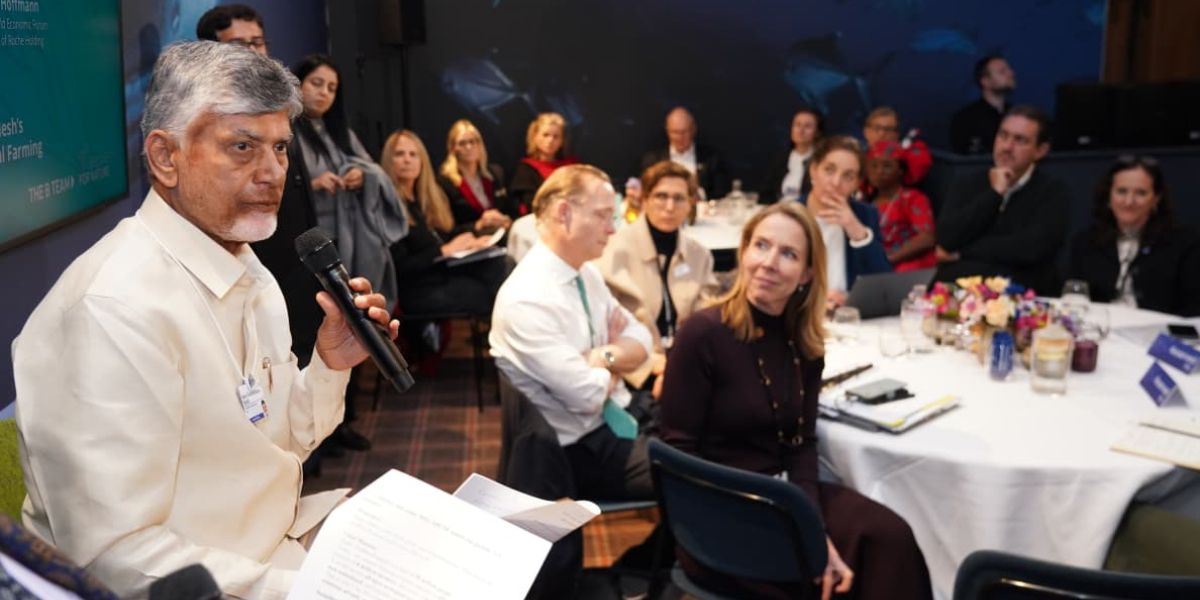
Andhra Pradesh Chief Minister Chandrababu Naidu speaking at WEF summit in Davos.
Synopsis: Andhra Pradesh Chief Minister N Chandrababu Naidu and Minister Nara Lokesh sought to position the state as a fast-moving, future-ready investment destination for green energy, advanced technologies, agriculture, food processing, quantum computing and skilling. During his four-day visit to Davos, the Chief Minister attended over 36 meetings, including interactions with 16 global business leaders.
Andhra Pradesh Chief Minister N Chandrababu Naidu and Minister for Education, IT and Electronics Nara Lokesh sought to position the state as a fast-moving, future-ready investment destination at the World Economic Forum (WEF) summit in Davos, Switzerland, for green energy, advanced technologies, agriculture, food processing, quantum computing and skilling.
Addressing the media, Naidu said the Davos platform was invaluable for understanding rapidly changing global industrial trends and investor sentiment. He said that Andhra Pradesh’s participation in WEF meetings had already translated into investment commitments of around ₹2.5 lakh crore.
“Global industry leaders are increasingly looking at India due to youth power, decisive leadership and investor-friendly policies. Davos helped us showcase Andhra Pradesh’s strengths effectively,” he said.
During his four-day visit, the chief minister attended over 36 meetings, including interactions with 16 global business leaders, including Tata Sons Chairman N Chandrasekaran, ArcelorMittal Chairman Lakshmi Mittal, Google Cloud CEO Thomas Kurian and IBM CEO Arvind Krishna.
Naidu said the state’s progress in green energy, artificial intelligence (AI), technology, agriculture and tourism was brought into sharp focus across these engagements. He also participated in meetings with delegations from Israel, the UAE and Switzerland, and attended multiple WEF sessions.
Naidu held discussions with Chandrasekaran on the Vizag TCS development centre, the proposed Quantum Valley in Amaravati and solar power projects in Kurnool. He urged the Tata Group to expedite tourism projects and explore investments in three proposed Sports Cities in the state.
Chandrasekaran assured cooperation and said Tata Trusts officials would hold detailed discussions on initiatives under the Ratan Tata Innovation Hub.
On the agriculture and exports front, Naidu met UAE Minister of State for Foreign Trade Thani bin Ahmed Al Zeyoudi, proposing Andhra Pradesh as a hub for horticulture, aqua and agri-product exports, food processing industries and a Dubai-linked food cluster.
Highlighting the state’s seaports, airports, road and rail connectivity, and its integration with national industrial corridors, the chief minister invited UAE companies, such as DP World, AD Ports, Sharaf Group, and ADNOC, to explore industrial parks and logistics investments.
He also pitched partnerships in renewable energy — where Andhra Pradesh targets 160 GW capacity — as well as in space and drone cities.
At a high-level WEF roundtable on natural farming and alternative crops, Naidu said Andhra Pradesh was preparing to become the world’s largest natural farming ecosystem, with 1.8 million farmers already adopting chemical-free practices across two million acres.
He underlined benefits such as lower input costs, higher net incomes from the first year, improved soil carbon storage, water efficiency and biodiversity, while stressing the need for global markets, certification systems and private-sector support to scale up natural produce exports.
Minister Lokesh complemented the chief minister’s outreach with a sharp focus on technology and governance. Speaking to Bloomberg, he revealed that the state government was studying Australia’s law banning social media access for children below 16, citing concerns over minors’ mental health and the need for a robust legal framework if such a policy were adopted.
Lokesh held a series of meetings with global technology and institutional leaders. He invited Accenture to set up a Global Delivery Centre in Visakhapatnam focused on AI, cloud and digital services, and to partner on skilling, quantum computing and startup innovation through the Amaravati Quantum Valley and Ratan Tata Innovation Hub.
He also met University of Cambridge Vice-Chancellor Prof Deborah Prentice, seeking collaboration on joint research, curriculum development, faculty exchanges and certified online courses on climate change and future skills for Andhra Pradesh students.
At the WEF Quantum Computing session, Lokesh announced that Andhra Pradesh would host South Asia’s most powerful quantum computer—IBM Quantum System Two with a 133-qubit processor — in Amaravati by July 2026, in partnership with IBM and TCS.
He said the state aimed to build a full quantum value chain, from skills and research to hardware manufacturing and exports, aligned with India’s National Quantum Mission.
Lokesh also met WEF Government Affairs Head Maroun Kheirouz to operationalise the WEF–AP Centre for the Fourth Industrial Revolution within a year, focusing on energy transition, cybersecurity and frontier technology governance. Meetings with Tech Mahindra CEO Mohit Joshi and Blackstone Chairman Stephen A Schwarzman explored investments in IT campuses, skilling hubs, mixed-use real estate, logistics parks and hyperscale data centres.
At an Andhra Pradesh state roundtable, Lokesh said the state was shifting from “ease of doing business” to “speed of doing business,” targeting recognition as a “Day-Zero Ready State” by 2035, with over 50 deregulation reforms undertaken in the past 18 months.
He also met Telangana Chief Minister A Revanth Reddy, with both leaders emphasising inter-state cooperation between the Telugu states for inclusive growth.
(Edited by Muhammed Fazil.)


