

Published Apr 29, 2026 | 3:02 PM ⚊ Updated May 12, 2026 | 11:43 AM

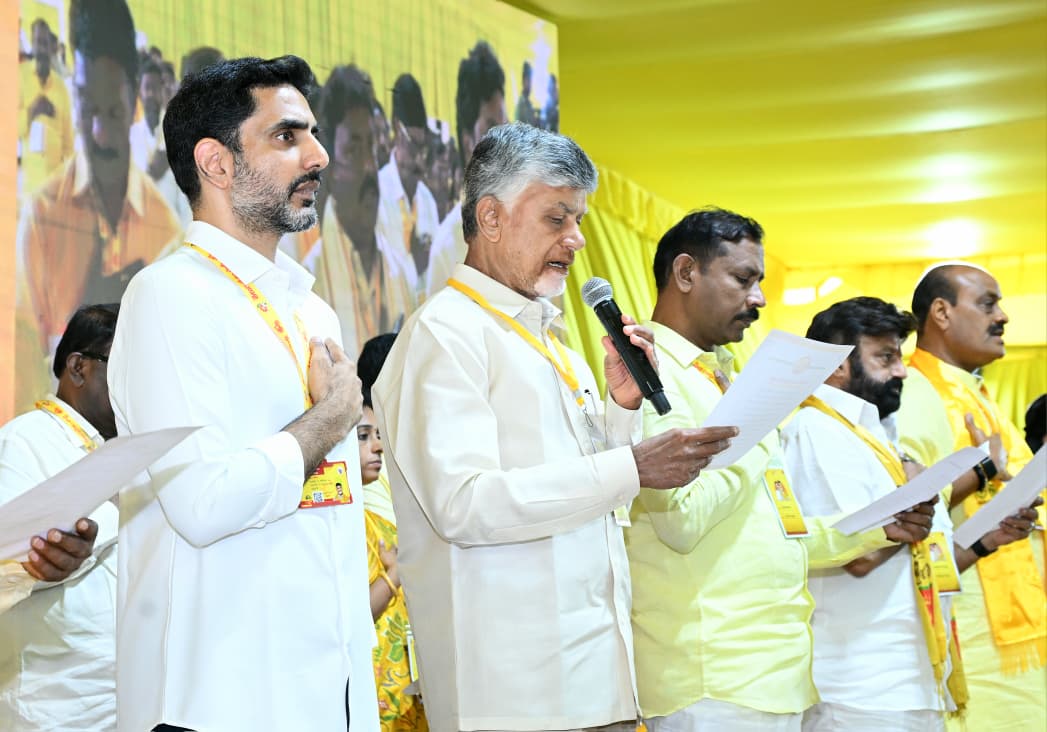
N Chandrababu Naidu administering the oath of office to Nara Lokesh and other TDP office bearers.

Synopsis: Nara Lokesh’s growth has been shaped by adversity, organisational experience, and a gradual shift toward direct voter engagement. Yet questions remain about whether he can build an independent political identity beyond what his father has established.
Andhra Pradesh IT and HRD Minister Nara Lokesh was, on Wednesday, 29 April, sworn in as the national working president of Telugu Desam Party (TDP) at the party’s central office at Mangalagiri in the Amaravati region.
TDP president and Chief Minister N. Chandrababu Naidu administered the oath to him at a ceremony organised for the installation of the party’s new executive.
In Andhra Pradesh politics, few journeys illustrate resilience and reinvention as vividly as that of Lokesh. Once derided by rivals and sections of the public as a political upstart operating in the shadow of his father, Chandrababu Naidu, the 43-year-old has steadily evolved into a leader with organisational depth, policy focus, and a more visible grassroots connect.
Lokesh’s elevation as the TDP national working president marks a seminal moment for him, formally setting the stage for an eventual generational transition while indicating internal consolidation within one of South India’s oldest regional parties.
Also Read: Is Naidu handing over the chief minister’s throne to Nara Lokesh?
Born on 23 January 1983 in Hyderabad to Chandrababu Naidu and Nara Bhuvaneswari —daughter of TDP founder NT Rama Rao — Lokesh grew up within a deeply political lineage.
His academic credentials include a BSc in Management Information Systems from Carnegie Mellon University and an MBA from Stanford Graduate School of Business.
His early political years were marked by scepticism, with critics portraying him as a dynastic entrant lacking the rhetorical appeal associated with his predecessors.
Lokesh’s formal political involvement began between 2009 and 2013, when he managed party affairs and election campaigns. As TDP general secretary from 2015, he oversaw a large-scale membership drive that deployed digital tools such as real-time dashboards and data tracking —methods that were then relatively new to the party.
In 2017, he entered the legislature as a Member of the Legislative Council and was inducted into the state cabinet, handling the IT portfolio. His tenure (2017–2019) saw initiatives in e-governance, including geo-tagging of assets, expansion of optical fibre networks, and the use of data-driven monitoring systems.
The state also attracted investments from companies such as Kia Motors and HCL during this period, as part of broader industrial outreach.
The electoral setback of 2019 marked a turning point. With the TDP out of power and Naidu facing political and legal challenges. including a high-profile incarceration in 2023. Lokesh encountered sustained criticism from the ruling YSR Congress Party.
Also Read: Nara Lokesh and Andhra — Extra-constitutional authority or poster boy?
Rather than beating a retreat, he recalibrated his approach. Observers noted changes in his public engagement, communication style, and outreach to party cadres.
A key milestone in this phase was the Yuva Galam padayatra, a 226-day march covering over 3,100 kilometres across nearly 100 Assembly segments ahead of the 2024 elections. The yatra helped rebuild cadre morale and expand direct engagement with voters, contributing to the TDP-led NDA alliance’s electoral performance in 2024.
Lokesh won from Mangalagiri and returned to the cabinet with portfolios including IT, Electronics & Communications, Real-Time Governance, and Human Resources Development.
His current role combines governance responsibilities with organisational leadership. The creation of the national working president post, unprecedented in the party’s history, points to a structured transition plan within the TDP, with Naidu retaining overarching control while delegating operational leadership.
Lokesh has worked his way up by consistently engaging with people. His regular weekend interactions have helped shape an image of accessibility, a quality often seen as rare in Andhra Pradesh politics.
Also Read: Lokesh emerging as the national face of TDP
However, Lokesh’s rise unfolds within the constraints of coalition politics. The TDP’s return to power in 2024 was not a standalone achievement but part of a broader NDA arrangement in the state. Within this framework, Pawan Kalyan and his Jana Sena Party remain critical stakeholders. Kalyan’s support base, particularly among youth and among Kapus, was a decisive factor in the alliance arithmetic.
This raises a key question for the future: how will coalition dynamics evolve during a leadership transition?
While Kalyan is lending his shoulder to Naidu in the present configuration, it is less clear how equations may shift when the question of succession becomes immediate. Coalition politics in Andhra Pradesh have historically been personality-driven, and Kalyan’s role is likely to remain central to the NDA’s stability. Whether he continues to play a supportive role or seeks greater political space when leadership equations change remains to be seen.
As far as Lokesh is concerned, he appears aware of this fluidity and has maintained a consistently respectful public equation with Kalyan.
Another variable is the potential, albeit uncertain, political entry of NT Rama Rao Jr., widely known as Jr NTR. Though the actor has repeatedly stated that he has no immediate interest in politics, his mass appeal and lineage make him a latent political factor.
As the grandson of NT Rama Rao, who founded the Telugu Desam Party in 1982, he is often seen by some as having a natural claim to its legacy. In a state where cinema and politics have long intersected, any shift by a figure of his stature could disrupt established formations.
The influence of film personalities in Andhra Pradesh politics is neither new nor negligible. Kalyan’s own trajectory from cinema to electoral relevance illustrates how quickly such transitions can reshape coalitions. A parallel can be drawn with developments in neighbouring Tamil Nadu, where film personalities like Vijay continue to bear political ambitions.
Also Read: ‘War-2’ leaves embers burning between Jr NTR and Lokesh fans
For Lokesh and the TDP, these variables introduce both opportunities and uncertainties. On one hand, coalition politics allows for broader social coalitions and electoral flexibility. On the other hand, it constrains unilateral decision-making and complicates succession planning.
Analysts point out that Lokesh’s growth has been shaped by adversity, organisational experience, and a gradual shift toward direct voter engagement. Yet, questions remain over whether he can build an independent political identity beyond what has been established by his father. The 2024 victory, while significant, was influenced by anti-incumbency and alliance factors as much as individual leadership.
Sustaining political momentum will depend on governance outcomes, economic delivery, and the ability to manage competing interests within the alliance. The balancing act between continuity and change, between legacy and individual assertion, is expected to define the next phase of his political trajectory.
As TDP’s working president, Lokesh now occupies a space that is both empowered and constrained: empowered by organisational authority, yet shaped by coalition compulsions and external uncertainties. In Andhra Pradesh’s fluid political landscape, the interplay between party structure, alliance dynamics, and potential new entrants will determine how that trajectory unfolds.
Political analyst and Navyandhra Intellectual Forum founder-chairman Prof. D.A.R. Subrahmanyam summed it up: Lokesh is a leader who converted adversity into opportunity. He said that Lokesh displayed remarkable poise and patience when Naidu was arrested under the YSRCP regime in 2023.
“Gold shines when it is put through fire,” he said, describing how tribulations had brought out the leader in him. He pointed out that contemporary Andhra Pradesh politics now revolves around three prominent younger leaders— Lokesh, Pawan Kalyan, and YS Jagan Mohan Reddy — and that the state’s political trajectory will become clearer as the leadership transitions unfold, possibly as early as next year’s Mahanadu.
(Edited by Majnu Babu).



