


Published Apr 04, 2026 | 8:00 AM ⚊ Updated Apr 04, 2026 | 8:00 AM

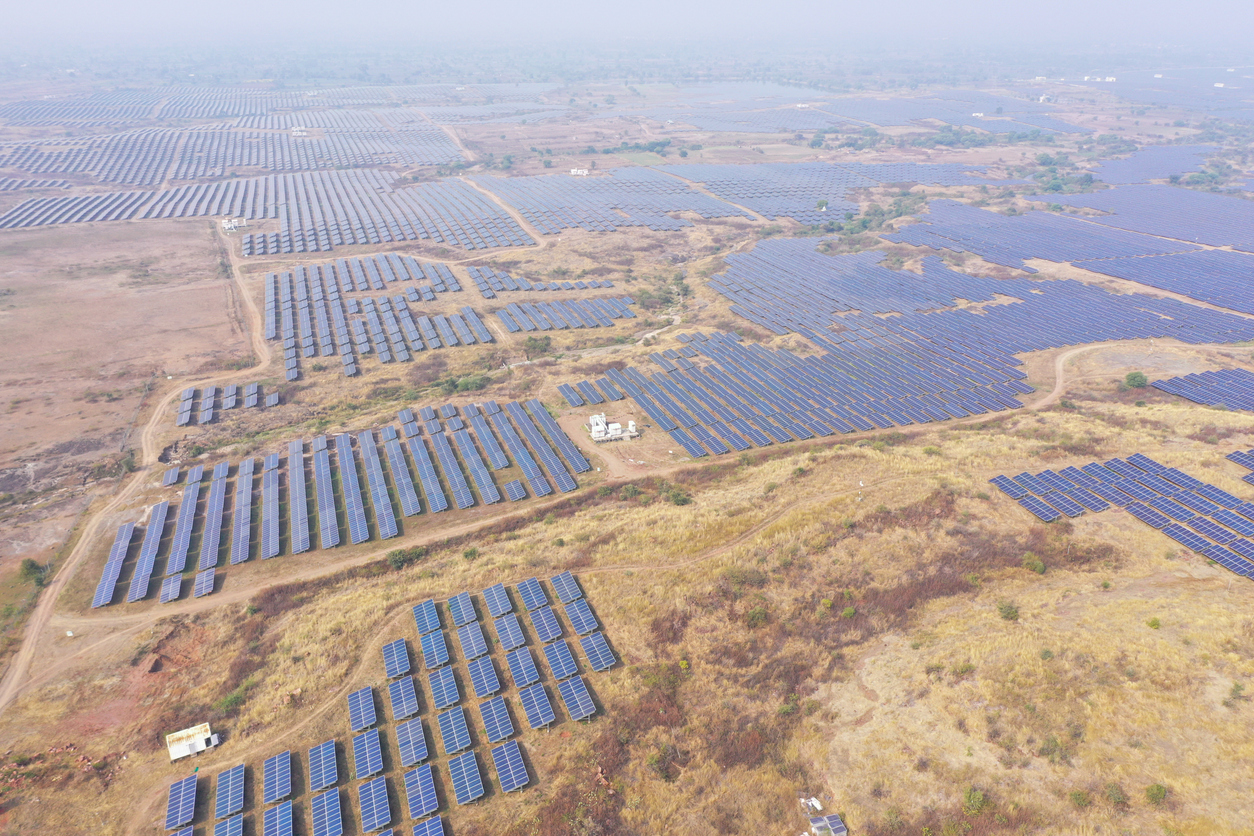
Aerial view of a solar energy generation park. (iStock/ representational)
Synopsis: An area of 466.54 acres in Mylavaram mandal of YSR Kadapa district and about 737.66 acres in Orvakal mandal of Kurnool district have been earmarked for the projects. Both parcels will be leased for 33 years to facilitate the development of grid-scale solar power plants.
The Andhra Pradesh government is fast tracking solar projects in the state. It has approved the allocation of government land in Kadapa and Kurnool districts for two ultra-mega solar parks, each with a capacity of 1,000 MW.
At the recent cabinet meeting, green-signal was given for transferring land to the Andhra Pradesh Solar Power Corporation Limited (APSPCL) for giving it on on a long-term lease to private developers, in line with the state’s policy on renewable energy projects.
An area of 466.54 acres in Mylavaram mandal of YSR Kadapa district and about 737.66 acres in Orvakal mandal of Kurnool district have been earmarked for the projects. Both parcels will be leased for 33 years to facilitate the development of grid-scale solar power plants.
Under the lease terms for the Kadapa project, rent is set at 10 percent of the prevailing 2016 market value, with a 10 percent escalation every five years. For the Kurnool project, the annual lease rent has been fixed at ₹20,000 per acre, based on a notional market value of ₹2 lakh per acre, also with 10 percent escalation every five years over the 33-year period.
Official sources said that the decision reflected a conscious policy shift towards the lease model instead of permanent alienation of public land. This approach, mandated under the state’s Solar Power Policy, aims to safeguard government ownership of land while still enabling large-scale private investment in clean energy infrastructure.
The land is being routed through APSPCL, the nodal agency for solar projects, which will then lease it out to private developers.
The move comes in the wake of the state government’s push to expand renewable energy capacity. Officials said that the two projects together will add 2,000 MW of solar capacity, contributing significantly to Andhra Pradesh’s renewable energy targets, reducing dependence on fossil fuels, and helping lower carbon emissions.
The policy is expected to attract investments, generate direct and indirect employment during construction and operations, and boost ancillary industries such as equipment supply, maintenance, and logistics. The Kurnool site, in particular, benefits from strong solar radiation and its location in an emerging renewable energy hub with large contiguous land parcels. Such ultra-mega solar parks will enhance energy security and stabilise power supply in the state, officials hope.
This decision is in line with Andhra Pradesh’s strategy of leveraging its favourable climatic conditions and land resources to position the state as a green energy hub. The government has multiple solar, wind, and hybrid projects in the pipeline.
But there are apprehensions that large-scale land allocations for industrial or energy projects have in the past raised concerns over alienation of public resources at concessional rates. By opting for a lease model with periodic escalations, the government appears to address such sensitivities while maintaining fiscal prudence and retaining ownership of the land.
Timely execution of these projects, however, will be key to meeting the state’s growing energy demands sustainably, officials said.
(Edited by Sumavarsha)


