


Published Feb 14, 2026 | 4:53 PM ⚊ Updated Feb 14, 2026 | 4:53 PM

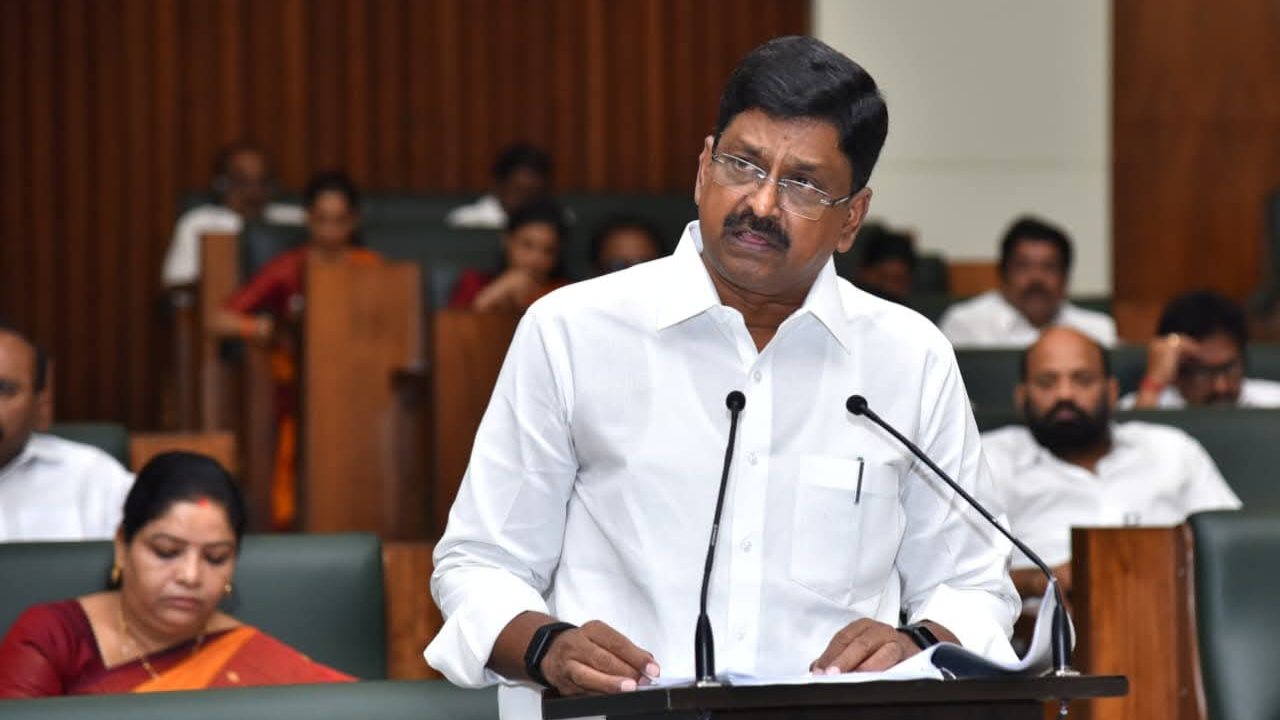
Andhra Pradesh Finance Minister Payyavula Keshav presenting the State Budget 2026-27. Credit: x.com/payyavulamla
Synopsis: Finance Minister Payyavula Keshav presented a ₹3.32 lakh crore Andhra Pradesh Budget for 2026–27, balancing welfare with capital spending. Key initiatives include a ₹30,000 crore Rayalaseema horticulture hub, free power for weavers, quantum computing push, and an AP Wealth Fund. Revenue and fiscal deficits are projected to decline, underscoring fiscal consolidation and growth revival.
Andhra Pradesh Finance Minister Payyavula Keshav on Saturday, 14 February, presented the state budget for 2026–27 in the Assembly, proposing a total expenditure of ₹3,32,205 crore and outlining a calibrated fiscal consolidation path with higher capital spending, debt rationalisation and economic revival.
Overall, the 2026–27 Budget reflects the state government’s intention to take up a balanced approach—combining welfare measures with investments in infrastructure, technology, and regional development to drive comprehensive growth.
Equal priority to welfare and development in its Budget. The focus is on accelerating economic growth, ensuring balanced regional development, and strengthening infrastructure through the implementation of new schemes.
Welfare and Development Focus
Rayalaseema Global Horticulture Hub:
A massive project outlay of ₹30,000 crore to transform Rayalaseema into a national and international hub for horticulture. The plan includes export promotion, food processing units, and the establishment of cold chain infrastructure.
Three city economic regions:
The government has decided to develop Visakhapatnam, Amaravati, and Tirupati as major economic growth centres.
Visakhapatnam, Amaravati, and Tirupati will be developed as Special Economic Regions with a focus on industry, IT, and services.
VB-G RAMG:
An allocation of ₹8,365 crore has been earmarked under this scheme to provide targeted benefits to socially and economically disadvantaged sections.
AP wealth fund:
A dedicated Wealth Fund will be established with an initial corpus of ₹100 crore to strengthen the State’s financial resources.
Free power for weavers
In a significant welfare measure for weavers:
500 units/month will be provided free to power loom units.
200 units/month will be provided free to handloom units.
The scheme will come into effect from April 2026 and is expected to benefit approximately one lakh families across the state.
Major Allocation for Education
₹1,800 crore has been allocated for improving infrastructure in schools and hostels.
The focus will be on renovation of buildings, drinking water facilities, toilets, and digital learning infrastructure.
Digital support for MSMEs
The government will implement TReDS (a digital bill discounting platform) in State Public Sector Undertakings to ensure timely payments to Micro, Small and Medium Enterprises (MSMEs), thereby improving their liquidity.
Boost to technology sector
Quantum computing project:
₹638 crore has been earmarked to position the State at the forefront of advanced technology. The initiative will support research, skill development, and startups in emerging technologies.
Social security measures:
Free bus travel will be provided to persons with disabilities.
Key Budget Numbers
For 2026–27, the minister proposed:
Total Expenditure: ₹3,32,205 crore
Revenue Expenditure: ₹2,56,143 crore
Capital Expenditure: ₹53,915 crore
Revenue Deficit: ₹22,002 crore
Fiscal Deficit: ₹75,868 crore
The Budget Estimates (BE) indicate an improvement over the 2025–26 Revised Estimates (RE). The revenue deficit is projected to fall sharply from ₹41,118.36 crore (RE 2025–26) to ₹22,002.50 crore in 2026–27. Similarly, the fiscal deficit is estimated to decline from ₹80,567.47 crore (RE) to ₹75,868.09 crore.
A major highlight of the Budget is the substantial increase in capital expenditure. Capital outlay is pegged at ₹53,915.38 crore in 2026–27, compared to ₹39,497.56 crore in the 2025–26 Revised Estimates — an increase of ₹14,417.82 crore.
The minister, in his budget speech, said the enhanced capital spending underscores the government’s commitment to asset creation and long-term growth.
Keshav recalled inadequate capital allocations under the previous YSRCP regime and how they had drawn criticism from audit authorities, including observations by the Comptroller and Auditor General (CAG) in various contexts. He informed the House that the government has undertaken negotiations with financial institutions to reduce high interest rates on loans contracted earlier.
According to him:
Interest rates on certain borrowings were reduced from 12.3 percent to 9 percent.
Discussions have been held to lower interest rates on loans amounting to ₹43,298 crore.
These efforts have resulted in annual savings of approximately ₹327 crore.
Negotiations are ongoing to reduce rates on another ₹1.20 lakh crore of loans, which, if successful, could yield estimated savings of ₹1,658 crore annually.
Keshav stated that ₹24,811 crore worth of pending bills left by the previous government have been cleared. To revive economic activity, the coalition government has spent ₹37,030 crore on irrigation and road works since assuming office.
For strengthening local bodies, ₹3,797 crore in Finance Commission grants have been transferred to panchayats and municipalities since the formation of the government.
Besides, ₹18,701 crore has been spent to restore 85 centrally sponsored schemes that were allegedly discontinued earlier, leading to improved flow of central funds.
Explaining the reforms undertaken, he said the government had improved the “Speed of Doing Business” and operationalised the TReDS digital platform. Under the SASCI mechanism, ₹6,544 crore has already been utilised, with another ₹1,438 crore expected to be drawn by the end of the financial year.
The Minister also announced the creation of the AP Wealth Fund, with an initial corpus of ₹100 crore. The state proposes to invest in projects across the country through this fund and has invited private investors to partner in the initiative.
Drawing parallels with sovereign fund models adopted by various countries, the government said the initiative aims to augment non-tax revenue and strengthen the state exchequer over time.
VB-G RAM G – ₹8,365 crore
Housing (Urban & Rural) – ₹5,451 crore
Dr. NTR Vaidya Seva Trust – ₹4,000 crore
Jal Jeevan Mission – ₹4,000 crore
Reproductive and Child Health – ₹2,144 crore
Swachh Bharat Mission – ₹1,037 crore
National Livelihood Mission – ₹955 crore
PM Ayushman Bharat Health Infrastructure – ₹838 crore
Department-wise allocations
School Education – ₹32,308.32 crore
BC Welfare – ₹23,650.88 crore
Panchayati Raj & Rural Development – ₹22,941.54 crore
Health & Family Welfare – ₹19,306.04 crore
Water Resources – ₹18,223.67 crore
Municipal Administration & Urban Development – ₹14,538.68 crore
Energy – ₹13,934.25 crore
Agriculture – ₹11,745.21 crore
Social Welfare – ₹11,118.84 crore
EWS Welfare – ₹10,699.33 crore
Revenue and expenditure composition
Sources of Revenue (Per Rupee):
Taxes – 38 percent
Non-tax revenue – 3 percent
Open market borrowings – 30 percent
Share in Central taxes – 19 percent
Grants-in-aid – 10 percent
Expenditure Pattern (Per Rupee):
Welfare – 17 percent
Education – 11 percent
Economic Services – 8 percent
Panchayat Raj & Rural Development – 7 percent
Health & Family Welfare – 6 percent
Water Resources – 6 percent
Municipal Administration & Urban Development – 4 percent
Energy – 4 percent
Agriculture & Allied Sectors – 4 percent
Interest Payments & Loan Repayment – 18 percent
Others (Home, R&B, Industries etc.) – 15 percent
Framing the Budget as a course correction after years of fiscal stress, the Finance Minister said the government’s twin priorities are restoring financial stability and accelerating growth through higher capital formation. The coming fiscal year, he asserted, will mark a transition “from repair to renewal” in Andhra Pradesh’s public finances.
Agriculture Minister K Atchannaidu presented state budget for agriculture for 2026-27. He allocated ₹ 53,752.12 crore for Agriculture and Allied departments which includes a budget allocation of ₹14,276 crore for Irrigation Department.


