

Published May 15, 2025 | 11:00 AM ⚊ Updated May 15, 2025 | 11:00 AM

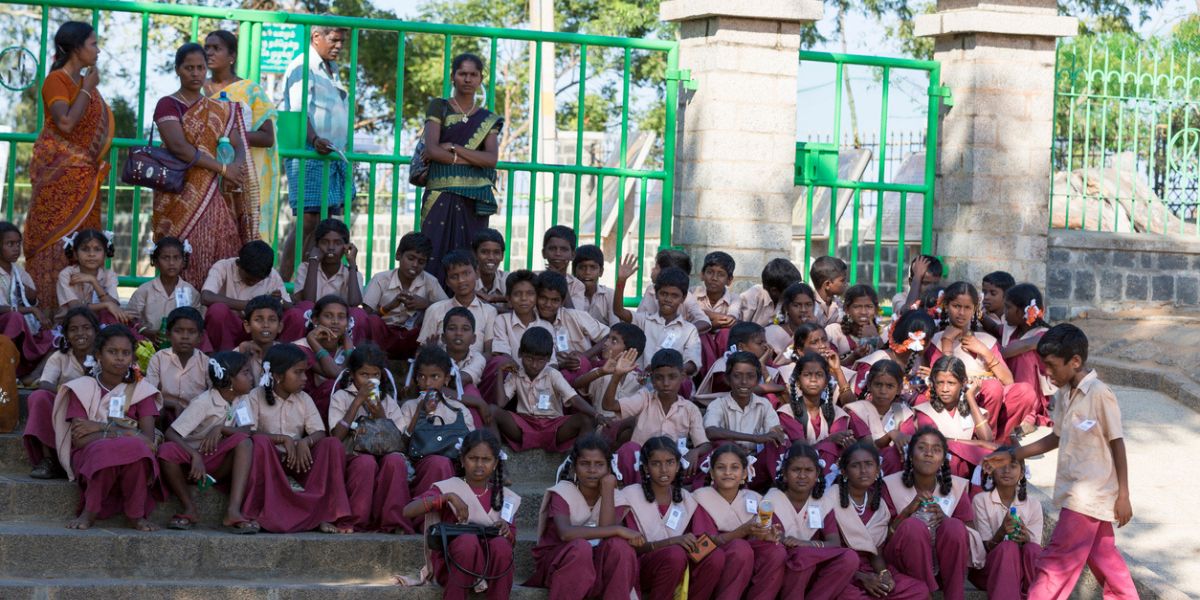
Students and teachers in a school. Representative Image. (iStock)

Synopsis: With rising demands to restore GO No.3, which provided 100 percent reservation of teachers’ posts in the agency areas for local tribals, the Andhra Pradesh government is exploring options to implement a new order. Officials are giving serious thought to addressing the objections pointed out by the apex court.
It is easier said than done to restore Government Order (GO) No. 3, which provided 100 percent reservation of teachers’ posts in the agency areas for local tribals in Andhra Pradesh.
Apparently keen on enlisting the support of the tribals, the TDP-led NDA government in the state has has decided to restore the GO, which was quashed by the Supreme Court in 2020.
In 2000, the then TDP government in the undivided Andhra Pradesh introduced the order but it was scrapped by the Supreme Court during a judicial review.
However, Chief Minister N Chandrababu Naidu is contemplating reissuing the GO after addressing the objections raised during the review.
State government officials are already working on how a fresh GO can be issued without the Supreme Court striking it down again. They are giving serious thought to addressing the objections pointed out by the apex court.
At a recent review meeting on the performance of the Tribal Welfare Department, the chief minister recalled that the government had issued a similar GO in 1986 itself, providing 100 percent reservation for local tribals in teacher posts in the agency areas.
Later, considering the increased percentage of women’s reservations, the state government brought in a fresh GO in 2000. Through its implementation, approximately 4,626 teacher jobs in agency areas were secured for tribals.
However, in 2002, some individuals approached the court regarding GO No. 3, and after hearings at various levels, the Supreme Court quashed the order in 2020.
The TDP alleges that the erstwhile YSRCP government was negligent in filing a watertight review petition, which led to the Supreme Court dismissing it. “As a result, tribals lost the benefits provided by GO No. 3,” the chief minister said recently.
Ahead of the 2024 Assembly elections, Naidu promised to restore GO No. 3. If that was not possible, he pledged to provide similar benefits to tribals through alternative means.
In line with this promise, the chief minister discussed the issue with officials. However, they have made little headway, as the Supreme Court raised several complex legal issues that are not easy to address.
The chief minister suggested that officials collect opinions from tribals and tribal associations regarding steps to restore the GO. In this context, he instructed them to examine how the benefits that were available under the GO could still be provided to the tribals by studying legal aspects, the Supreme Court’s objections, and possibly introducing fresh legislation to provide 100 percent reservation of teachers’ posts in tribal areas.
Officials are currently debating the appropriate quantum of reservation to recommend in the reissued GO. They are uncertain whether, as in the past, 100 percent reservation should be provided, or whether it should be based on population proportions, or capped at 50 percent, while also meeting the criteria set by the Supreme Court.
The chief minister said: “We are committed to the rights of tribals in tribal areas. As promised during the elections, we are committed to restoring GO No. 3 or ensuring justice for tribals at the same level. Consultations with constitutional and legal experts at the national level should also be held on this issue.”
GO No. 3 was issued by the Andhra Pradesh government on 10 January 2000. It provided 100 percent reservation for Scheduled Tribe (ST) candidates in teaching posts in schools located in Scheduled Areas, with a sub-reservation of 33 percent for Scheduled Tribe (ST) women. However, this order was quashed by the Supreme Court in 2020, and there have been ongoing protests and demands for its reinstatement.
The GO aimed to promote education in tribal areas and address the chronic absenteeism of non-tribal teachers in Scheduled Areas, where schools often faced staffing shortages due to the reluctance of non-tribals to work in remote regions. The order also aimed to protect the interests of local ST communities by reserving all teaching jobs for them.
The government argued that it issued the GO under Para 5(1) of the Fifth Schedule of the Indian Constitution, which allows the Governor to modify or exempt laws in Scheduled Areas to safeguard tribal interests. It cited the need to improve literacy.
Between 2000 and 2020, approximately 11 General and Special District Selection Committees (DSCs) filled teaching posts in Scheduled Areas exclusively with local ST candidates, significantly boosting tribal employment in education.
However, the Supreme Court, in a landmark ruling on 22 April 2020, struck down GO No. 3, declaring it unconstitutional. The case, Chebrolu Leela Prasad Rao vs State of Andhra Pradesh, was decided by a five-judge Constitution Bench. The bench ruled that the 100 percent reservation exceeded the 50 percent cap set by the 1992 Indra Sawhney v Union of India judgment.
The bench called the notion that “only tribals should teach tribals” an “obnoxious” and “arbitrary” concept, arguing that it denied opportunities to other qualified candidates, including those from Scheduled Castes (SCs), Other Backward Classes (OBCs), and open-category candidates.
The court also found no verifiable data or studies to support the claim that 100 percent reservation was necessary to address absenteeism or improve tribal education.
The court found that GO No. 3 effectively created a new reservation policy, bypassing the Andhra Pradesh Regulation of Reservation and Appointment to Public Services Act, 1997, which caps ST reservations at 6%. The order was seen as violating Article 16(1) (equality of opportunity in public employment) and Article 14 (right to equality) by discriminating against non-tribal candidates.
After the GO was scrapped, tribal communities in Andhra Pradesh and Telangana strongly opposed the ruling, viewing it as a denial of their constitutional protection under the Fifth Schedule.
They argued that the 100 percent reservation had improved literacy (tribal literacy was 59 percent compared to the national average of 73 percent according to the 2011 Census) and empowered local STs by employing teachers familiar with tribal languages and terrain.
Bandhs were observed in tribal areas, including Visakhapatnam, Alluri Sitarama Raju, and Adilabad districts, with support from groups like the Adivasi Employees and Teachers’ Associations, Girijana Sankshema Sangham, and Tudum Debba. Protesters demanded reinstatement of GO No. 3 or the enactment of a new law to restore the quota.
As recently as 2 May 2025, Alluri Sitarama Raju district saw road blockades and the closure of shops and tourist sites, with tribals recalling Chief Minister Naidu’s election promise to revive 100 percent reservation.
Tribal Welfare Minister Gummidi Sandhya Rani has stated that the coalition government is working on an alternative GO to replace No. 3. She noted that 2,024 of the 16,437 DSC posts are currently reserved for tribals, countering claims of neglect.
In Telangana, the government has expressed its intent to file a review petition and explore legal options to restore tribal quotas.
Tribal leaders and groups like the Human Rights Forum argue that the 100 percent reservation was not merely a quota, but a mechanism to ensure culturally relevant education and address systemic absenteeism. They claim the policy’s success — evidenced by filled posts and stable schools — proves that it met its goals, contrary to the court’s assertion of arbitrariness.
(Edited by Muhammed Fazil.)



