

Published Mar 13, 2026 | 8:22 PM ⚊ Updated Mar 13, 2026 | 8:22 PM

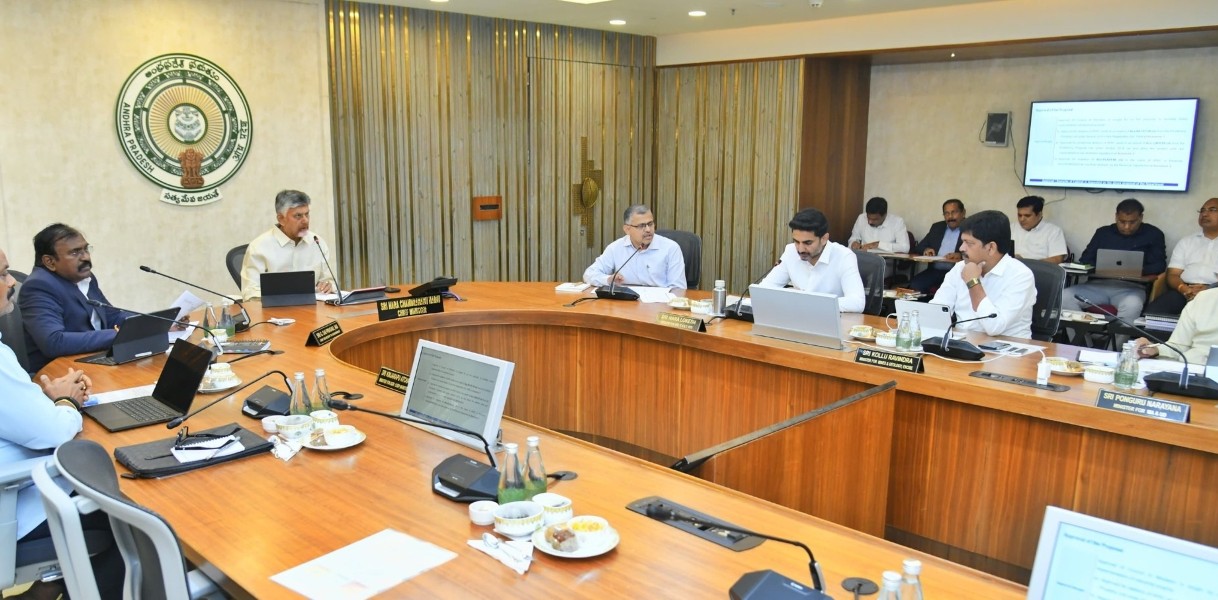
Andhra Pradesh Cabinet meeting. (AndhraPradeshCM/ X)
Synopsis: For years, nearly 75,000 acres of industrial land allocated by APIIC remained in the restricted list, making it difficult for industries to use those properties as collateral for bank loans. Industrial units could neither mortgage the land nor formally execute sale or lease agreements. This created uncertainty about ownership rights even after the completion of industrial units, slowing down project implementation and discouraging fresh investment.
The Andhra Pradesh Cabinet, chaired by Chief Minister N Chandrababu Naidu, on Friday, 13 March, cleared a series of key policy and infrastructure decisions aimed at accelerating industrial investment, strengthening irrigation infrastructure, and improving public services across the state.
Information and Public Relations Minister K Parthasarathi, briefing media persons on the decisions taken at the cabinet meeting, said that one important proposal that had been approved was the removal of restrictions on thousands of acres of industrial land that had been stuck under the prohibitory property list. The Cabinet approved the proposal to remove about 66,157 acres of land allotted by the Andhra Pradesh Industrial Infrastructure Corporation (APIIC) from the Section 22-A prohibitory property list under the Registration Act.
For years, nearly 75,000 acres of industrial land allocated by APIIC remained in the restricted list, making it difficult for industries to use those properties as collateral for bank loans. Industrial units could neither mortgage the land nor formally execute sale or lease agreements. This created uncertainty about ownership rights even after the completion of industrial units, slowing down project implementation and discouraging fresh investment.
The Cabinet’s decision aims to permanently resolve this bottleneck. The move would enable entrepreneurs to access institutional credit more easily, speed up industrial projects, and generate employment. In addition, the Cabinet approved the mutation of around 51,603 acres of government and other lands directly in the name of APIIC in revenue records, as a one-time measure. The government believes that removing these legal hurdles will significantly improve the ease of doing business in the state.
In another industrial development-related decision, the Cabinet approved the technology upgradation and expansion of the dairy processing unit of Heritage Foods at Kashipenta village in Chandragiri mandal of Tirupati district. The project, with an investment of ₹209.68 crore, has been granted special incentives under the state’s Food Processing Policy 4.0.
Classified as a mega project, the expansion will substantially enhance production capacity. Flavoured milk output is expected to increase by 131 percent, paneer production by 400 percent, and ghee production by 566 percent. The state government will provide incentives including technology upgradation subsidies, power tariff concessions of ₹1 per unit, and 100 percent reimbursement of State GST for five years.
The Cabinet reviewed a wide range of issues across departments and approved measures aimed at governance reforms, infrastructure development and welfare initiatives.
In a major infrastructure push for the capital region, the Cabinet granted administrative approval for ₹2,316.88 crore worth of MEP works — including electrical systems, HVAC, fire protection, lifts and plumbing — for the Integrated AP Secretariat and Head of Departments towers in Amaravati. Construction of the Secretariat complex had stalled in 2019 but resumed in June 2024 after safety clearance from a committee of experts including the Indian Institute of Technology Madras.
The Cabinet also approved ₹119.27 crore for the construction of a Telugu Cultural Centre at Neerukonda in Amaravati. Planned in five acres, the facility will include a 2,000-seat grand auditorium, a 1,000-capacity open-air theatre and a Telugu language museum. Designed as a green building compliant with IGBC and GRIHA standards, the centre aims to showcase Telugu art, literature and cinema at national and international levels.
The Cabinet also approved a proposal to upgrade 300 Head Constable posts in the Andhra Pradesh Special Police (APSP) battalions into Assistant Reserve Sub-Inspector (ARSI) positions. The decision is expected to improve command and control in platoons during law-and-order duties, disaster response operations and VIP security arrangements.
To promote entrepreneurship, the Cabinet cleared the Andhra Pradesh Chief Minister Employment Generation Programme (AP-CMEGP). Under the scheme, ₹300 crore will be allocated to support about 3,500 micro entrepreneurs who intend to establish manufacturing units in the state’s 175 MSME parks. The initiative is expected to create around 17,000 jobs over the next four years.
The scheme will provide margin money subsidies ranging from 25 to 35 percent for entrepreneurs belonging to SC, ST, BC, women and differently abled categories. Instead of direct payment, the subsidy amount will be kept as a fixed deposit for three years and later adjusted against the beneficiary’s loan account.
Significant decisions were also taken in the agriculture sector. The Cabinet approved extending 100 percent subsidy for drip irrigation and 90 percent subsidy for sprinkler irrigation for Forest Rights Act (FRA) patta holders in eight tribal districts under the Per Drop More Crop programme. The measure is intended to help tribal farmers in rain-fed areas improve agricultural productivity.
To address drinking water shortages, the Cabinet cleared seven Multi-Village Scheme (MVS) projects worth ₹9,355 crore, which are expected to supply safe drinking water to about 65 lakh people across 76 mandals. Besides, ₹1,814.71 crore was sanctioned for 3,000 drinking water works in water-stressed habitations under rural water supply programmes supported by schemes such as the Jal Jeevan Mission.
The Cabinet also approved several land allocations for public institutions. Government land was allotted for establishing Kendriya Vidyalayas in multiple districts including NTR district, Eluru district and Srikakulam district, aimed at providing quality education to children of central government employees and local students.
In the irrigation sector, additional funds were sanctioned for critical works related to the Polavaram Irrigation Project, including extra gantry equipment and tunnel lining works in Packages 63 and 64. The government has set a target to complete key tunnel works by June 2026, ahead of the earlier schedule.
(Edited by Sumavarsha)


